
 |
 |
 |
 |
 |
 |
 |
 |
 |

 |
Galileo Leads The Race Against Russia's Glonass
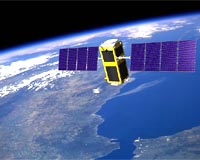
political commentator Moscow (RIA Novosti) Jul 14, 2008 The European Commission has decided to start buying satellites and ground-based equipment for its Galileo satellite navigation project. By 2010, the system should comprise 30 satellites and a ramified ground infrastructure. Europe's independence from the U.S. Global Positioning System (GPS) will cost it 3.4 billion euros by 2013. But the European Commission thinks it is worth it. Galileo, an initiative launched by the European Union and the European Space Agency, will provide information concerning the positioning of users in many sectors such as transport (vehicle location, route searching, speed control, guidance systems, etc.), social services (aid for the disabled or elderly), the justice system and customs services (location of suspects, border control), public projects (geographical information systems), search and rescue systems, or leisure (direction finding at sea or in the mountains, etc.). Good for Europe, but what about Russia's Glonass? In the mid-2000s it was declared a priority national project and a successful commercial undertaking capable of rivaling Europe's Galileo and America's Navstar (NAVigation Satellites providing Time And Range) GPS. In the past few years, though, we have seen that it cannot rival either. Moreover, it is not clear why Glonass is not progressing as fast as it should. The success of any undertaking in space or on the Earth depends on the goals and conditions for attaining them, as well as allocations and deadlines. The more uncertain and vague they are, the fewer chances a project has. We know from Soviet and Russian history that when a project is described as "global" and "a national priority," and the more special programs are approved and special commissions established, the fewer the project's chances. Glonass was first proposed in 1982 and took off quite well as a military project. But the demise of the Soviet Union in 1991 brought down the system of satellite navigation. In 2001, Glonass was declared a priority national project for the space sector and the national economy as a whole. A special federal targeted program was approved for its implementation. It was also given a new goal - to compete with the U.S. and European programs in attracting commercial users. In other words, we have been trying to turn a purely scientific and technical project into yet another symbol of Russia's greatness, without clearly formulating tasks for the navigation satellites. Lack of funds for the program has forced us to review it twice, in 2006, when the task was set to increase the number of the group's satellites, and in late May 2008, when the government approved the goal of increasing the production of Glonass sets to create a vast market of users. We are again presenting the program as a commercial project, a lucrative business, which it cannot be. So far, there have been no more than 16 of the planned 18 Glonass satellites in orbit to cover the entire Russian territory, although '18' is also something of an arbitrary figure. Russian research institutes have conducted mathematical modeling studies that prove that 18 satellites can ensure only 70% reliability of positioning. I'm not sure we will have the 30 satellites required for a truly reliable system in the foreseeable future. As for Glonass receivers, the questionable achievements of Russian producers of household radio electronics make me wonder. And then, who will use Glonass' services, and where? Are we doing anything to develop a market for navigation satellites' data? There is no reliable information about any of these elements, although it has been reported that Russian and foreign cargo transportation companies working in Russia have been supplied with Glonass sets. But this is not a market, and not a commercial business. And lastly, Galileo, which was announced as a commercial project in 1999, has been marking time until 2007 because of haggling between the EU countries over investment and revenues. Some of them have questioned the very possibility of profiting from satellite navigation. Eventually, a thorough business analysis put an end to disputes and commercial considerations, and the program became a purely budget project with net expenses estimated at 3.4 billion euros. Maybe Russia should do the same with its Glonass system? But where will it find the money? You say everything is cheaper in Russia? Don't make me laugh. The only solution is to reassign the task of developing satellite navigation to those who really need it, the army. The opinions expressed in this article are the author's and do not necessarily represent those of RIA Novosti.
Source: RIA Novosti Community Email This Article Comment On This Article Share This Article With Planet Earth
Related Links GPS Applications, Technology and Suppliers
 Carrier Commercial Service Selects Trimble For Mobile Resource Management
 Sunnyvale CA (SPX) Jul 11, 2008
Trimble has announced that Carrier is rolling out Trimble's Mobile Resource Management (MRM) solution within its Carrier Commercial Service (CCS) fleet. |
|
|

| The content herein, unless otherwise known to be public domain, are Copyright 1995-2007 - SpaceDaily.AFP and UPI Wire Stories are copyright Agence France-Presse and United Press International. ESA Portal Reports are copyright European Space Agency. All NASA sourced material is public domain. Additional copyrights may apply in whole or part to other bona fide parties. Advertising does not imply endorsement,agreement or approval of any opinions, statements or information provided by SpaceDaily on any Web page published or hosted by SpaceDaily. Privacy Statement |
 del.icio.us
 Digg
Digg Reddit
 YahooMyWeb
 Google
 Facebook