
 |
 |
 |
 |
 |
 |
 |
 |
 |

 |
GAO Report Reveals Continuing Problems With NPOESS
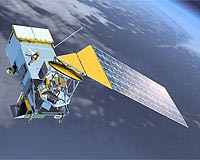
Washington DC (SPX) Jun 24, 2008 Today, the House Committee on Science and Technology's Energy and Environment Subcommittee continued its oversight of the National Polar-Orbiting Operational Environmental Satellite System (NPOESS). "This program is vital to our daily lives," said Subcommittee Chairman Nick Lampson (D-TX). "When launched, NPOESS will be the primary source of information the National Weather Service uses to make its long-range forecasts, and the military will need NPOESS data to plan operations around the globe." However, the program continues to experience management and technical problems. Mr. Dave Powner of the Government Accountability Office (GAO) testified on the latest report concerning the troubled weather satellite program, and the Administrator of the National Oceanic and Atmospheric Administration (NOAA), Conrad Lautenbacher, responded. Recent events have once more raised questions about the stability of the program, including a new threat to the most critical instrument. Key documents have still not been finalized and approved by the Executive Committee, the tri-agency body that oversees the NPOESS program. GAO testified that this is unacceptable. This continued delay in decision-making may create new management risks, and Mr. Lampson expressed concern that such delays stored up more trouble for the future. Costs increases persist in the program. Testimony from GAO indicates that the likely lifetime cost has grown to between $13.5 - $14 billion, at least a billion dollars over the $12.5 billion estimated for the recertified program in 2006. GAO states that the increases come from the costs needed to correct instrument problems over the last year, the possible cost of upgrading computer security standards for the ground network, and a better estimate of the cost of running the system until its scheduled end in 2026. Technical questions continue to arise about the primary instrument, the Visible Infrared Imaging Radiometer Suite (VIIRS). NOAA had announced week that screw heads were found to be sheared off and that it might be necessary to replace all screw assemblies, once again delaying delivery of the sensor and launch of the precursor satellite, the NPOESS Preparatory Project mission. This came just after VIIRS had caused an 8-month launch delay to resolve an earlier problem with its cooling radiator. NOAA Administrator Lautenbacher testified that updated information now indicates the problem may not involve the entire instrument and that delays can be avoided. "This is not the situation we hoped to be in at this point in time," said Lampson. "The risk of a data gap is growing along with the cost of this program. We need to know how these problems are going to be resolved and when we can expect some good news." Community Email This Article Comment On This Article Share This Article With Planet Earth
Related Links House Committee on Science and Technology Earth Observation News - Suppiliers, Technology and Application
 Jason-1 Will Make It's 30,000th Orbit
 Washington DC (SPX) Jun 20, 2008
The Jason-1 spacecraft will make its 30,000th science orbit this week. Revolution number 30,000 will begin at 10:27 UTC (3:27 a.m. PDT) on June 14th, 2008 and will be completed at 12:19 UTC (5:19 a.m. PDT). From its vantage point 1,336 kilometers (830 miles) above Earth, Jason-1 uses its radar altimeter to precisely measure the topography of the ocean surface. |
|
|

| The content herein, unless otherwise known to be public domain, are Copyright 1995-2007 - SpaceDaily.AFP and UPI Wire Stories are copyright Agence France-Presse and United Press International. ESA Portal Reports are copyright European Space Agency. All NASA sourced material is public domain. Additional copyrights may apply in whole or part to other bona fide parties. Advertising does not imply endorsement,agreement or approval of any opinions, statements or information provided by SpaceDaily on any Web page published or hosted by SpaceDaily. Privacy Statement |
 del.icio.us
 Digg
Digg Reddit
 YahooMyWeb
 Google
 Facebook