|
 |
 |
 |
 |
 |
 |
 |
 |

 |
Future Combat Systems Team Opens Field Test Center In New Mexico
St. Louis (SPX) Oct 25, 2006 Boeing and partner Science Applications International Corporation (SAIC), as the Lead Systems Integrator for the U.S. Army's Future Combat Systems (FCS) program, yesterday celebrated the opening of the Army's Test Operation Complex at White Sands Missile Range (WSMR), N.M. The complex will support experimentation, test, training and integration activities for the Army's Evaluation Brigade Combat Team (EBCT) -- a unit tasked with testing and evaluating FCS technologies as they come online beginning in 2008. "Yesterday's event emphasizes the transition from concept to reality, as the Army, LSI and industry partners come together in support of critical testing to field FCS; and is indicative of the Army's commitment to the program," said Dennis Muilenburg, vice president-general manager, Boeing Combat Systems, and program manager, FCS. "Continuing to build on our close relationship with the Army, the LSI and our partners stand ready to support the testing and fielding of FCS technologies, which will enable our nation's soldiers to conduct their missions more effectively and safely." The opening of the Test Operation Complex represents the formal kick-off of the supporting capability for the EBCT. It is another in a series of milestones designed to ensure a seamless transition for the soldiers in the unit as they begin evaluating and operating the networked system of manned and unmanned ground and air vehicles and sensors that comprise FCS. The mission of the EBCT, comprising 947 soldiers initially but expected to grow to more than 3,000 soldiers by 2014, will be to evaluate all FCS systems as they mature in preparation for fielding, with an initial focus on the systems and technology slated for accelerated delivery to the current force. These technologies include initial networking capabilities, Unattended Ground Sensors, the Non-Line-of-Sight -- Launch System and the Intelligent Munitions System, which are intended to fill existing capability gaps and enhance the effectiveness and survivability of current troops. In February 2006, the LSI opened a regional office in El Paso, Texas, and pre-positioned a small core team of technical support personnel on post at WSMR and Fort Bliss, Texas to support Army activities. The team is working closely with the U.S. Army Training and Doctrine Command's Future Force Integration Directorate, which is responsible for coordinating, synchronizing and supporting the execution of the FCS family of systems, and for facilitating the stand-up and evolution of the EBCT. The number of industry personnel has since grown to more than 30 individuals who are assisting the Army with fielding support, force development planning, test support and soldier training. Additionally, more than 125 engineers are temporarily residing in the region, supporting FCS experimentation activities, which are currently under way at the WSMR/Fort Bliss complex. Soldiers and leaders in the EBCT will build on lessons learned during Experiment 1.1, a three-phased event led by the LSI in partnership with the Army and best-of-industry team. This experiment combines laboratory experiments with field exercises where soldiers will have an opportunity to use early versions of FCS systems and work with initial doctrinal concepts. Phase 1 of the experiment, completed in September, was a laboratory-based event conducted at the System of Systems Laboratory in Huntington Beach, Calif., that focused on hardware and software integration and systems interoperability. Phase 2, which runs from September to December, involves gathering data and assessing systems performance while operating in a realistic environment at the WSMR/Fort Bliss combined range complex, with soldiers on hand for observation. Phase 3, scheduled for January to February 2007, builds upon the engineering work of the previous lab and field experiment phases by demonstrating that FCS systems, integrated with various other Army systems, are developing at their target maturity levels. Experiment 1.1, Phase 3 will be the first time these integrated systems will be used by soldiers in an operational framework over a real terrain. Early hands-on feedback from soldiers will be incorporated back into the FCS program in preparation for the early delivery of the first FCS technologies to the current force in 2008. Community Email This Article Comment On This Article Related Links Integrated Defense Systems Science Applications International Corporation The latest in Military Technology for the 21st century at SpaceWar.com Military Space News at SpaceWar.com
 Boeing To Build More Wideband Gapfiller Satellites
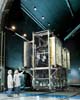 St Louis MO (SPX) Oct 19, 2006
Boeing and the U.S. Air Force MILSATCOM Systems Wing have signed a $1.067 billion contract for up to three more Wideband Gapfiller Satellites (WGS), if all options are exercised. The Block II satellites will be similar to the three Block I satellites already in production. Under Block II, Boeing will add a radio frequency bypass capability designed to support airborne intelligence, surveillance and reconnaissance platforms requiring ultra-high bandwidth and data rates demanded by unmanned aerial vehicles. |
|
|

| The content herein, unless otherwise known to be public domain, are Copyright 1995-2006 - SpaceDaily.AFP and UPI Wire Stories are copyright Agence France-Presse and United Press International. ESA PortalReports are copyright European Space Agency. All NASA sourced material is public domain. Additionalcopyrights may apply in whole or part to other bona fide parties. Advertising does not imply endorsement,agreement or approval of any opinions, statements or information provided by SpaceDaily on any Web page published or hosted by SpaceDaily. Privacy Statement |