|
 |
 |
 |
 |
 |
 |
 |
 |

 |
Follow The Sun ... In Stereo
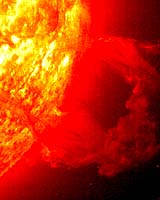
St Paul MN (SPX) Oct 18, 2006 Like geologists poring over seismograph records to identify the telltale signature of an imminent earthquake, University of Minnesota researchers are poised to probe the sun for a tipoff that a huge eruption of its corona is brewing. Called coronal mass ejections, or CMEs, these solar castoffs can wreak havoc with satellites, whole nations' power grids and the well-being of astronauts. The university-designed and built instruments aboard the twin spacecraft of NASA's STEREO mission--currently scheduled for launch Oct. 25 from Cape Canaveral, Fla.--will detect waves of energy and charged particles emitted by the sun via processes that may help cause CMEs. "As our society becomes more electronic and sophisticated, these outbursts become more disruptive," said Paul Kellogg, a retired physics professor who is part of the university's space physics team. "STEREO will allow us to see when one is coming to Earth." The $400 million STEREO mission is the first to use the moon's gravity to "slingshot" more than one spacecraft into orbit. As the two spacecraft circle the moon, the moon will first throw one into orbit trailing Earth and then, a month later, hurl the second into orbit moving ahead of Earth. As the distance between the spacecraft widens, they will gain a stereoscopic perspective on the sun that will allow cameras and other instruments aboard to detect the direction in which any CMEs are traveling. The University of Minnesota team has worked closely with researchers at the Paris Observatory to design and build instruments for their joint experiment, called S/WAVES (short for STEREO WAVES). The university's instruments will be able to track the shock wave that precedes a CME as it moves through space. "It's all to understand and predict how the sun works," said university physicist Keith Goetz, the project manager for S/WAVES. "We hope to get moving pictures of CMEs and solar flares. We want to be able to look at the surface of the sun and say, for example, 'There's going to be an eruption-right there, in that spot.'" It will be the first of the experiments aboard STEREO to be turned on following launch. Community Email This Article Comment On This Article Related Links Solar Science News at SpaceDaily Solar Science News at SpaceDaily
 Cluster Muscles Back From Deep Hibernation
 Paris, France (SPX) Oct 09, 2006
On 15 September, flight controllers at ESA's Space Operations Centre watched tensely as 'Rumba', No. 1 in the four-spacecraft Cluster fleet, was switched into a low-power, deep hibernation mode. The aim was to survive a challenging eclipse. |
|
|

| The content herein, unless otherwise known to be public domain, are Copyright 1995-2006 - SpaceDaily.AFP and UPI Wire Stories are copyright Agence France-Presse and United Press International. ESA PortalReports are copyright European Space Agency. All NASA sourced material is public domain. Additionalcopyrights may apply in whole or part to other bona fide parties. Advertising does not imply endorsement,agreement or approval of any opinions, statements or information provided by SpaceDaily on any Web page published or hosted by SpaceDaily. Privacy Statement |