|
 |
 |
 |
 |
 |
 |
 |
 |

 |
Fingertip Device Helps Computers Read Hand Gestures
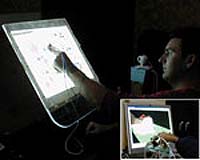
Los Angeles (SPX) Aug 15, 2006 With the tap of a single finger, computer users soon may be drawn deeper into the virtual world using a new device developed in the University at Buffalo's Virtual Reality Lab. UB researchers say their "Fingertip Digitizer," which users wear on the tip of the index finger, can transfer to the virtual world the meaning and intent of common hand gestures, such as pointing, wagging the finger, tapping in the air or other movements that can be used to direct the actions of an electronic device, much like a mouse directs the actions of a personal computer, but with greater precision. What's more, the Fingertip Digitizer can transfer to personal computers very precise information about the physical characteristics of an object -- and even can sense the shape and size of a human gland or tumor -- when a user taps, scratches, squeezes, strokes or glides a finger over the surface of the object. "The gesture-recognition function of this device, in particular, has great potential for a wide range of applications, from personal computing to medical diagnostics to computer games," says Young-Seok Kim, who received his doctoral degree in mechanical engineering from UB in May. Kim created the Fingertip Digitizer with Thenkurussi Kesavadas, director of UB's Virtual Reality Lab and associate professor of mechanical and aerospace engineering in the UB School of Engineering and Applied Sciences. According to Kesavadas, the Fingertip Digitizer will help bridge the gap between what a person knows and what a computer knows. "With this device a computer, cell phone or computer game could read human intention more naturally," he explains. "Eventually the Fingertip Digitizer may be used as a high-end substitute for a mouse, a keyboard or a joystick." Kim and Kesavadas will demonstrate a prototype of the Fingertip Digitizer at the SIGGRAPH2006 technology conference Aug. 1-3 in Boston. They expect the Fingertip Digitizer and related software to be market- ready within three years. The creators of the year's best research innovations in computer graphics and interactive techniques are invited to SIGGRAPH2006, the largest conference of its type in the world. The Fingertip Digitizer is a major enhancement in haptic technology, an emerging field focused on bringing a sense of touch to technological devices, according to Kim and Kesavadas. Most haptic tools on the market are designed as probes and are gripped like a pen. They can be difficult to manipulate and therefore may not give a precise representation of the object the user is feeling. The Fingertip Digitizer's design, the researchers explain, is modeled after the biomechanical properties of a finger, which means it can more accurately and intuitively sense the physical properties of an object. To sense touch and movement, the device uses a force sensor, an accelerometer and a motion tracker -- all contained in thimble-sized device that fits comfortably on a user's finger. A real-time, multi-rate data acquisition system used with the Fingertip Digitizer reads the force feedback exerted by an object as it is touched by the user. To read hand gestures, the system tracks the acceleration and location of the fingertip device as the finger moves and gestures. A touch screen is not required. With the device attached to the fingertip, the user simply would gesture in the air as he looks at a computer screen where a software program or computer game may be running. In this way, the user can direct the opening or moving of an electronic file, for example. Using the device as a computer-game accessory, the user could imitate the squeezing of a trigger or the stroking of pool cue, for example, say Kim and Kesavadas. A provisional patent application has been filed on the device. The researchers are developing Touch Painter and Touch Canvas software to accompany the Fingertip Digitizer. Using this software and the Fingertip Digitizer, the user will be able to apply digital paint to a computer-screen canvas with a few flicks or taps of the index finger. Community Email This Article Comment On This Article Related Links UB Virtual Reality Lab All about the technology of space and more Space Technology News - Applications and Research
 Sandia Piezoelectric Film Package To Be Part Of Space Station Experiment
 Albuquerque NM (SPX) Aug 09, 2006
For the past three years a Sandia research team headed by Mat Celina has been investigating the performance of various piezoelectric polymer films that might one day serve as ultra-light mirrors in space telescopes. |
|
|

| The content herein, unless otherwise known to be public domain, are Copyright 1995-2006 - SpaceDaily.AFP and UPI Wire Stories are copyright Agence France-Presse and United Press International. ESA PortalReports are copyright European Space Agency. All NASA sourced material is public domain. Additionalcopyrights may apply in whole or part to other bona fide parties. Advertising does not imply endorsement,agreement or approval of any opinions, statements or information provided by SpaceDaily on any Web page published or hosted by SpaceDaily. Privacy Statement |