|
 |
 |
 |
 |
 |
 |
 |
 |

 |
Sandia Piezoelectric Film Package To Be Part Of Space Station Experiment
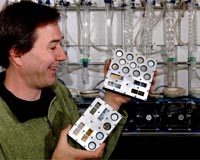
Albuquerque NM (SPX) Aug 09, 2006 For the past three years a Sandia research team headed by Mat Celina has been investigating the performance of various piezoelectric polymer films that might one day serve as ultra-light mirrors in space telescopes. In 2007 the research will go one step further when a Labs' experimental package of promising polymers will be part of a NASA experiment on the upcoming Materials International Space Station Experiment (MISSE-6) to be launched into low Earth orbit (LEO). "This will be the first time these polymers will be remotely operated in an actual space environment," Celina says. "We hope to learn which polymer materials will work best in space. The materials will boldly go where they have not been before." Sandia delivered the package to NASA in May, and it will become one of many polymer performance experiments conducted on MISSE-6. Lightweight piezoelectric polymers based on polyvinylidene fluoride (PVDF) and its copolymers expand and change shape when an electric field is applied. They have not been used much in space because they degrade when exposed to the conditions of LEO, such as atomic oxygen, solar UV (ultraviolet), and temperature variations. To be successful as space mirrors, the polymer films, which would be covered with a metallic coating, will have to be able to survive the rigors of space. Space telescopes equipped with piezoelectric polymer films will be quite different from the Hubble, which was deployed into orbit in 1990 and uses the traditional polished glass mirror approach, and the James Webb Space Telescope scheduled for launch in 2013, which will be made of 18 beryllium mirror segments. Instead, the new polymer film mirrors would be lightweight, and - because of their piezoelectric qualities - could adjust focal lengths when electrical fields are remotely applied. "NASA and Boeing have been running experiments with polymers in space for some time," Celina says. "The space materials community first looked extensively at polymers in space in the late 1980s. They launched a large satellite, the LDEF - Long Duration Exposure Facility - and found significant polymer degradation issues. The Hubble had polymer degradation problems as well, with its thermal control blankets." The research team spent the past three years developing and testing polymers in an effort to identify the ones that just might work best. "We did many experiments on the ground both at Sandia and with the support of NASA-Glenn," Celina says. "We managed to do as complete a testing as possible before we put the polymer films in space. Our [former] postdoc Tim Dargaville was instrumental in conducting a comprehensive evaluation program. Many other Sandia staff with specialized equipment also assisted." As part of the experiments the research team measured how the piezoelectric material would change in different circumstances and identified a range of materials. The team experimented with a variety of polymers, including some that were off-the-shelf and others that were specially created. After coming up with the most promising polymers, the materials were placed in a 6-inch by 6-inch sample holder designed by Gary Jones that is part of the MISSE-6 experimental package. This experimental unit will be launched as part of a larger suitcase-type container where experiments from a range of universities and other agencies will be assembled as well. Astronauts will attach the container to the International Space Station during a spacewalk and will open it inside out to expose the samples. Depending on which side of the container the samples are located, they will either receive primarily vacuum UV (VUV) radiation or both VUV and atomic oxygen exposure. Both passive experiments, which are not hooked up to electric excitation, and active experiments, which will be connected to high voltage, will be flown, allowing for a range of experiments and materials to be tested over the course of the exposure - estimated to be six to eight months. The degradation trends and loss in performance caused by exposure to the space elements will be monitored in real-time and logged into NASA-qualified data-loggers. When the loggers are returned to Earth, Sandia researchers will analyze the data to determine which materials were able to best survive the harsh space environment. Celina anticipates it will take at least one year to evaluate the materials and data to decide which polymers might be best suited for space mirrors. "This work has been really interesting and a personally rewarding and challenging project," Celina says. "We've done fundamental science on the piezoelectric polymers and, once the experiment in space is completed, we'll be able to provide real scientific feedback to engineers intending to use such polymer films in space." Community Email This Article Comment On This Article Related Links Space Mirror Sandia National Laboratories Space Technology News - Applications and Research
 NG Begins Work On Dedicated Facility For High-Energy, Solid-State Laser System
 Redondo Beach CA (SPX) Aug 04, 2006
Northrop Grumman, moving quickly to consolidate its recent achievements in solid-state lasers, has begun constructing a dedicated facility for system integration work and low-rate production of high-energy lasers for military weapon systems. |
|
|

| The content herein, unless otherwise known to be public domain, are Copyright 1995-2006 - SpaceDaily.AFP and UPI Wire Stories are copyright Agence France-Presse and United Press International. ESA PortalReports are copyright European Space Agency. All NASA sourced material is public domain. Additionalcopyrights may apply in whole or part to other bona fide parties. Advertising does not imply endorsement,agreement or approval of any opinions, statements or information provided by SpaceDaily on any Web page published or hosted by SpaceDaily. Privacy Statement |