|
 |
 |
 |
 |
 |
 |
 |
 |

 |
Extreme Physics Observatory Ready for Final Assembly
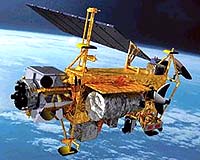
Scottsdale AZ (SPX) Sep 22, 2006 The primary instrument for NASA's Gamma-ray Large Area Space Telescope (GLAST) arrived at General Dynamics, Scottsdale, Ariz., on September 18 for mounting onto the spacecraft. The instrument, called the Large Area Telescope, successfully completed four months of vigorous testing last week at the U.S. Naval Research Laboratory, Washington, to ensure it can withstand the rigors of launch and operations in space. "GLAST is a remarkable undertaking, a partnership between astronomers and physicists," said Peter Michelson, GLAST principal investigator at Stanford University, Calif. "We are eagerly anticipating a new understanding of the connections between the large and small, between the most energetic phenomena in the universe and the subatomic world." The observatory will detect light billions of times more energetic than what our eyes can see or what optical telescopes can detect. Key targets include powerful particle jets emanating from enormous black holes and possibly the theorized collisions of dark matter particles. The Large Area Telescope will be at least 30 times more sensitive than previous gamma-ray detectors and will have a far greater field of view. "The Large Area Telescope is a unique and beautiful new instrument for science, and it will provide a tremendous leap forward in our ability to study the most energetic objects and phenomena in space," said Steven Ritz, project scientist at NASA's Goddard Space Flight Center, Greenbelt, Md. Unlike visible light, gamma rays are too energetic to be focused by traditional telescope mirrors onto a detector. The Large Area Telescope will employ detectors that convert incoming gamma rays into electrons and their antimatter partners, called positrons. This technique, a change of light into matter as described by Einstein's equation E=mc^2, is called pair conversion. It will enable scientists to track the direction of gamma rays and measure their energy. The Large Area Telescope was assembled at the Stanford Linear Accelerator Center in Menlo Park, Calif., from subsystems developed by an international team from Italy, Japan, France, Sweden and the United States. The second main instrument, the GLAST Burst Monitor, arrived in Scottsdale, Ariz., in July and is currently being integrated onto the spacecraft. The GLAST Burst Monitor was built at NASA's Marshall Space Flight Center, Huntsville, Ala., in collaboration with scientists from the Max Planck Institute for Extraterrestrial Physics, Garching, Germany, working with NASA through an agreement with the German Aerospace Center. GLAST is scheduled to launch from NASA's Kennedy Space Center, Fla. in fall 2007. Community Email This Article Comment On This Article Related Links GLAST website Stellar Chemistry, The Universe And All Within It Space Telescope News and Technology at Skynightly.com
 In Chile, Global Project Builds Sharpest Eye On Universe
 Cerro Paranal, Chile (AFP) Sep 06, 2006
High on the driest desert on the planet, an army of international scientists is assembling Earth's most powerful observatory to search for the answers of the universe. |
|
|

| The content herein, unless otherwise known to be public domain, are Copyright 1995-2006 - SpaceDaily.AFP and UPI Wire Stories are copyright Agence France-Presse and United Press International. ESA PortalReports are copyright European Space Agency. All NASA sourced material is public domain. Additionalcopyrights may apply in whole or part to other bona fide parties. Advertising does not imply endorsement,agreement or approval of any opinions, statements or information provided by SpaceDaily on any Web page published or hosted by SpaceDaily. Privacy Statement |