|
 |
 |
 |
 |
 |
 |
 |
 |

 |
In Chile, Global Project Builds Sharpest Eye On Universe
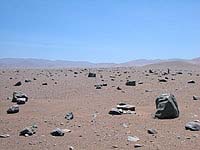
Cerro Paranal, Chile (AFP) Sep 06, 2006 High on the driest desert on the planet, an army of international scientists is assembling Earth's most powerful observatory to search for the answers of the universe. Known by its English-language initials ALMA -- or "soul" in Spanish -- the ambitious radio telescope array will be the first global astronomical project, a European, US and Japanese collaboration in which Chile is participating. For Chile's Atacama Desert is at the center of the world's astronomical research, thanks to nearly perfect conditions: exceptionally clear skies and negligible humidity, the next best thing to outer space. Atmospheric humidity would absorb the millimeter and the submillimeter wavelengths the scientists developing the Atacama Large Millimeter Array (ALMA) will study. The observatory is under construction in the Chilean Andes, the 5,000-meter-high (16,400-foot)-high Zona de Chajnantor, east of the village of San Pedro de Atacama, by an international collaboration of European, US and Japanese scientists. The location gets an annual average of 10 millimeters (0.39 inch) of rain and offers the best conditions for radioastronomy, which explores the universe via radio waves from galaxies, stars, quasars and other phenomena. Combined with data collected by telescopes, such as the ESO Very Large Telescope at the Paranal Observatory in Atacama, the world's largest and most advanced optical telescope, scientists believe that ALMA will be able to see deep into the origins of the universe. When completed -- around 2011 -- ALMA's will be the largest and most capable eye on the sky, expected to wield a resolution 10 times sharper than the Hubble Space Telescope. ALMA will study distant galaxies, the first light of the universe; the formation of planets and stars; quasars and other celestial phenomena. Each of the 64 12-meter (40-foot) antenna dishes will be movable, to allow for configuration to suit the particular research. Data collected by the antenna array will be fed into a powerful computer that will perform 16,000 million-million operations per second. "It will be a gigantic eye, unique for its potential to receive data on the birth of the universe," William Garnier, a spokesman for the European Southern Observatory (ESO), an intergovernmental European organization that is part of the project, told AFP. The budgeted cost of the project exceeds 600 million dollars and is mainly shared by ESO, representing 11 European countries; Associated Universities, Inc., a US organization that unites the resources of the federal government, universities and research groups; and Japan. Chile notably has conceded the land for ALMA. The complexity of the project is not only complicated by the international aspect of communications, but also by the location itself. Construction of the massive project in the barren region poses the challenges of supplying electricity, water and security for the equipment. And the high altitude is not only difficult for humans. Some of the equipment cannot withstand the atmospheric pressure and must be operated at a distance, at a lower altitude. "It is a project of great complexity," a project leader, Chilean engineer Eduardo Donoso, told AFP. Work began in November 2003 with the construction of the first control center building, located 5,100 meters (16,700 feet) above sea level, and now has reached the second, bigger phase, at the base camp at 2,900 meters (9,500 feet) altitude. The bases for the antennas will begin to take shape in the coming months, and three companies -- from Europe, the US and Japan -- will arm them with the antennas. The first assembled antenna is expected to be completed by April 2007.
Source: Agence France-Presse Community Email This Article Comment On This Article Related Links Stellar Chemistry, The Universe And All Within It Space Telescope News and Technology at Skynightly.com
 Hubble Captures A Rare Eclipse On Uranus
 Baltimore MD (SPX) Sep 01, 2006
This NASA Hubble Space Telescope image is a never-before-seen astronomical alignment of a moon traversing the face of Uranus, and its accompanying shadow. The white dot near the center of Uranus' blue-green disk is the icy moon Ariel. |
|
|

| The content herein, unless otherwise known to be public domain, are Copyright 1995-2006 - SpaceDaily.AFP and UPI Wire Stories are copyright Agence France-Presse and United Press International. ESA PortalReports are copyright European Space Agency. All NASA sourced material is public domain. Additionalcopyrights may apply in whole or part to other bona fide parties. Advertising does not imply endorsement,agreement or approval of any opinions, statements or information provided by SpaceDaily on any Web page published or hosted by SpaceDaily. Privacy Statement |