|
 |
 |
 |
 |
 |
 |
 |
 |

 |
Evacuation No Option For Randstad Flood
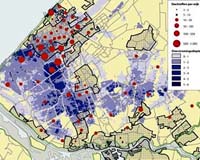
Delft, Holland (SPX) Dec 07, 2006 A flood in the southern Randstad will claim thousands of victims. And evacuating the area would only save precious few lives, TU Delft researcher Bas Jonkman states in the latest edition of Delft Outlook (Delft Integraal). If the seawalls at Den Haag and Ter Heijde are breached and the fast-flowing seawater floods the polder land behind the dikes, there will be more than 4,000 casualties, according to a new calculation method devised by TU Delft PhD candidate Bas Jonkman. Jonkman's method also reveals that evacuating this area would only save at most 600 lives. "It's possible to predict a North Sea storm a day or two in advance," Jonkman says. 'But before an evacuation could begin, the government would deliberate and everyone would have to be warned. Then, people would pack up their belongings. All this would cost a lot of time." However, in the less densely populated polder lands along the rivers, if people were warned well enough in advance of an impending flood, Jonkman's model predicts that an evacuation would indeed save many lives. For the densely populated polders bordering the coastline, Jonkman says it would be more effective for example to build stronger and higher dikes, as this would reduce the likelihood of a flood. Until now, various rules of thumb have been used to estimate the number of possible casualties resulting from a flood. Jonkman's model for estimating casualties is more precise. It consists of various parts, including a model that simulates an evacuation and thereby determines how many people would still be in the area if the dike were breached. Determining how many of these people would survive is dependent on how fast the water flows, how fast the water rises and how deep the water is. To make such predictions, Jonkman uses a model that was developed by TU Delft and the research institute WL Delft Hydraulics. Jonkman combined the models to simulate the evacuation and the course of the flood. The majority of Jonkman's doctoral research was devoted to devising the so-called 'victim functions'. 'If the water is four meters deep, then 20 percent of the people in that area would not survive', is an example of how this function works. For the victim functions, Jonkman based his data on the calamitous flood in the Netherlands in 1953 and other such disasters. To determine if his model's findings were realistic, Jonkman also processed data from the floods caused by Hurricane Katrina in August 2005, when the dikes protecting New Orleans were breached. Jonkman's model calculated 2,000 victims for that disaster - a figure that Jonkman is pleased with: "This is of the same order of magnitude as the 1,100 bodies that have actually been recovered so far." An in-depth article about this research subject has been published in the latest edition of Delft Integraal / Delft Outlook, the independent science magazine of TU Delft. Community Email This Article Comment On This Article Related Links Delft Outlook Bringing Order To A World Of Disasters When the Earth Quakes A world of storm and tempest
 Researchers Learn From Analyses Of Rare Tsunami Earthquake
 Atlanta GA (SPX) Dec 07, 2006
Analyses of a classic, slow-rupturing tsunami earthquake whose massive waves devastated the coast of Java, Indonesia, this past summer are providing insight to seismologists and engineers, who want to better understand these rare events, recommend strategies to improve safety and perhaps provide long-range forecasts of potential danger zones worldwide. |
|
|

| The content herein, unless otherwise known to be public domain, are Copyright 1995-2006 - SpaceDaily.AFP and UPI Wire Stories are copyright Agence France-Presse and United Press International. ESA PortalReports are copyright European Space Agency. All NASA sourced material is public domain. Additionalcopyrights may apply in whole or part to other bona fide parties. Advertising does not imply endorsement,agreement or approval of any opinions, statements or information provided by SpaceDaily on any Web page published or hosted by SpaceDaily. Privacy Statement |