|
 |
 |
 |
 |
 |
 |
 |
 |

 |
Eutelsat's Hot Bird 7A Arrives At Kourou From Alcatel Alenia Space Facilities
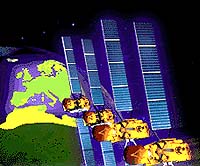
Paris (SPX) Jan 23, 2006 The HOT BIRD 7A broadcasting satellite, built by Alcatel Alenia Space for Eutelsat Communications, arrived last Thursday night at the Kourou launch site in French Guiana. The satellite's scheduled launch date is 21 February 2006 on-board an Ariane 5 ECA rocket. HOT BIRD 7A will be positioned at 13 degrees East, Eutelsat's prime neighbourhood for television and radio broadcasting to satellite and cable homes. Equipped with 38 Ku-band transponders, its dual mission is to replace existing capacity at 13 degrees East and, in conjunction with HOT BIRD 8 which is due for launch in second quarter, to provide complete in-orbit redundancy at the HOT BIRD location. Eutelsat's HOT BIRD neighbourhood today hosts 850 television channels and 550 radio stations, serving 110 million homes in Europe, North Africa and the Middle East. With Alcatel Alenia Space as prime contractor (platform and payload), HOT BIRD 7A continues a long history of industrial cooperation with Eutelsat that over almost 20 years has seen orders placed for 16 satellites*. Based on Alcatel Alenia Space's Spacebus 3000B3 platform, HOT BIRD 7A has a launch mass of more than 4 tonnes and its solar panels will deliver 10 kW of electrical power. The satellite's lifetime is 15 years. * 5 EUTELSAT II (F1 to F5), HOT BIRD 1, HOT BIRD 6, HOT BIRD 7A, W2, W3, W4, W5, SESAT 1 (with NPO-PM) EUROBIRD 1, ATLANTIC BIRD 2, ATLANTIC BIRD 3. Community Email This Article Comment On This Article Related Links Eutelsat Communications Alcatel Alenia Space Launch Pad at Space-Travel.com
 Japan H2 Heavy Lofts Disaster Monitoring Satellite
 Tokyo (AFP) Jan 24, 2006
The Japan Aerospace Exploration Agency on Monday postponed until Tuesday the first launch in a year of its key H-2A rocket, which will carry a satellite to monitor disasters, due to a technical error. |
|
|

| The content herein, unless otherwise known to be public domain, are Copyright 1995-2006 - SpaceDaily.AFP and UPI Wire Stories are copyright Agence France-Presse and United Press International. ESA PortalReports are copyright European Space Agency. All NASA sourced material is public domain. Additionalcopyrights may apply in whole or part to other bona fide parties. Advertising does not imply endorsement,agreement or approval of any opinions, statements or information provided by SpaceDaily on any Web page published or hosted by SpaceDaily. Privacy Statement |