|
 |
 |
 |
 |
 |
 |
 |
 |

 |
Saturn's Methane Moon
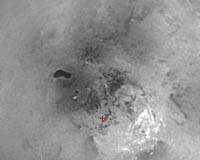
for Astrobiology Magazine Moffett Field CA (SPX) Sep 04, 2006 Saturn's moon Titan seems to have little in common with Earth. At just 93 Kelvin, the giant moon is beyond ice cold, and its atmosphere is dominated by methane rather than nitrogen and oxygen. But in July, radar on NASA-ESA's Cassini-Huygens mission found a landscape with a striking resemblance to Earth. Titan has long been known for its dense "smoggy" atmosphere containing a preponderance of methane, but the smog obscured visible light, so hard data about the surface - and on methane's behavior -- was scanty. Radar, however, can see through this smog, and on July 22, Cassini's fifth flyby of Titan revealed dark regions with clear borders near Titan's north pole. The simplest explanation for the areas of low radar reflectivity is that they signify bodies of liquid -- lakes. Rocky surfaces tend to return a radar signature, but a quiet liquid surface does not. If the lake explanation survives scientific scrutiny, these would be the first non-terrestrial lakes ever detected that currently contain liquid. That liquid is probably methane, according to Jonathan Lunine, a professor of planetary sciences at the University of Arizona. With gaseous methane in the atmosphere and liquid methane on the ground, the lakes are also likely linked in a dynamic gas-liquid system that parallels Earth's hydrosphere. "Half a century after Gerard Kuiper first found methane on Titan, the Cassini-Huygens mission has discovered a methanosphere on Titan," says Lunine. Radar works by emitting microwaves and then "reading" the reflections. Unless the radar is looking directly down, the surface of a still liquid will not reflect microwaves back to the radar's receiver. And an extreme absence of microwaves is exactly what Cassini "saw," says Larry Soderblom, Cassini interdisciplinary scientist at the U.S. Geological Survey, Flagstaff, Ariz. "North of 75 degrees, all of sudden we saw these lake-like things that have a radar reflectivity as close to zero as you can get. They basically popped out." Some of the dark patches were also linked to dark, linear regions that resemble drainages that feed lakes on Earth, he adds. The finding was not entirely surprising. Even during Cassini's first radar flyby, says Lunine, "there were very small, dark areas close to the equator that may be methane lakes." At Xanadu, where the Huygens lander touched down after being released by Cassini, dark areas between ridges looked as if they could have been formed by liquid methane. But Lunine says the shapes seen near the north pole "were very dramatic, they stand out with tremendous contrast against the background, and the forms are very suggestive of things filled with liquid. This is probably the first definitive detection of methane lakes." Other evidence for a methanosphere comes from the Huygens landing site, Soderblom says. "We have seen things that clearly indicate surface runoff." This suggests that the liquid that carved the valleys came from methane rain rather than from seepage from underground. Because Cassini's radar can resolve features 500 to 1,000 meters (roughly 1600 to 3300 feet) across, further observations may find seasonal changes in the methane lakes. The sun's warmth, moving between the northern and southern hemispheres, could evaporate the lakes, releasing methane gas in the warmer hemisphere, which may then fall as methane rain in the colder one. As on Earth, the gas-liquid system may have sub-surface manifestations. Previous calculations have indicated that methane in the interior may be reaching the surface in outgassing episodes spaced roughly 1 billion years apart, Lunine says. "Some of this methane would end up in the atmosphere, and some at the surface in lakes or seas." Lunine suggests today's methane could be the remnant of an outgassing a few hundred million years ago, a suggestion based partly on the fact that radar images of some equatorial regions show empty holes -- perhaps dry lakes. A methane molecule contains a single carbon atom. The methane that formed these depressions was probably converted by solar-powered processes into the two-carbon hydrocarbon ethane, and eventually into other hydrocarbons and "a whole suite of nitrogen-bearing molecules," Lunine says. Under the right conditions, these simple molecules could become the building blocks of life. While most methane on Earth is produced by microbes, Titan's methane probably has a non-biological origin, says Lunine. "Methane is the easiest organic molecule to make in an environment like Titan's; it does not call for a biogenic explanation." Titan's large store of methane may have been trapped when the satellite formed along with Saturn, or it could have been made in the moon's interior, through a reaction among carbon dioxide, water and rocks. Overall, Titan is a picture of activity, Lunine says. "These data are showing us that methane does sit on the surface in lakes, it does get dumped by big methane thunderstorms, it does carve rivers and streams (although not as often perhaps as on Earth), and it does undergo chemical reactions that produce other organic compounds." The titanic discovery of methane-filled lakes helps reinforce a picture of Titan as the second-most complicated world in the solar system, and the Cassini-Huygens mission is revealing surprising parallels with Earth, says Soderblom. "We expected it to be quite complicated, to have a bizarre chemistry, and to be quite lively and active on the surface. I think the thing that was most startling is how Earth-like it appeared. It's like taking terrestrial geological processes and swapping out the chemicals and temperature, and having the same kind of rivers, rains, lakes, aeolian [wind-driven] processes, volcanism, tectonism, impact processes. It's basically the lexicon of Earth-like geological activity with different materials." "I think Titan is unique in the solar system for having such an active cycling of volatiles," adds Lunine. "Mars paints a marvelous picture of an ancient time when it had a hydrosphere, 3 billion years ago," but aside from Earth, "no body is known to have such active cycling of elementary compounds. Venus lost its hydrosphere very early . Europa is capped by ice, but has none of the same kind of atmospheric effects. Titan is unique, and that makes it a more intriguing world to study. Titan is an analog of the active Earth, without the biology and with methane replacing water." Community Email This Article Comment On This Article Related Links Cassini at JPL Cassini images Explore The Ring World of Saturn and her moons Explore The Ring World of Saturn and her moons Jupiter and its Moons The million outer planets of a star called Sol News Flash at Mercury
 ESA Releases Huygens Scientific Archive Data Set
 Paris, France (SPX) Aug 03, 2006
Since ESA's Huygens probe successfully descended through the atmosphere of Titan, Saturn's largest moon, and safely landed on its surface on Jan. 14, 2005, the data it collected have revealed an extraordinary new world. |
|
|

| The content herein, unless otherwise known to be public domain, are Copyright 1995-2006 - SpaceDaily.AFP and UPI Wire Stories are copyright Agence France-Presse and United Press International. ESA PortalReports are copyright European Space Agency. All NASA sourced material is public domain. Additionalcopyrights may apply in whole or part to other bona fide parties. Advertising does not imply endorsement,agreement or approval of any opinions, statements or information provided by SpaceDaily on any Web page published or hosted by SpaceDaily. Privacy Statement |