|
 |
 |
 |
 |
 |
 |
 |
 |

 |
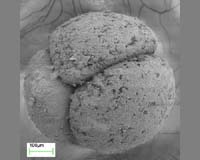
Embryo Fossils Reveal Animal Complexity 10M Years Before Cambrian Explosion
Amherst MA (SPX) Oct 16, 2006 Fossilized embryos predating the Cambrian Explosion by 10 million years provide evidence that early animals had already begun to adopt some of the structures and processes seen in today's embryos, say researchers from Indiana University Bloomington and nine other institutions in this week's Science. James Hagadorn of Amherst College led the multi-disciplinary international collaborative project. The researchers from the U.S., U.K., China, Sweden, Switzerland and Australia report the first direct evidence that primitive animals 550 million years ago were capable of asynchronous cell division during embryonic development. Asynchronous cell division allows the formation of unique shapes. "We're learning something about how the very earliest multicellular animals formed embryos and how the embryos developed," said IU Bloomington biologist Rudolf Raff, a coauthor of the report. "This gives us an enormous and entirely surprising look at half-a-billion-year-old embryos in the act of cleaving. What a window on the past. We've had no prior idea what they might have done." The researchers also believe they've identified specialized structures inside the cells, such as bubble-like vesicles that the cells might have used to transport, store or metabolize molecules. Slight aberrations during the fossilization of dead embryonic cells even reveal what appear to be dividing nuclei. It was assumed such structures existed in early animals, but until now, no known fossils of the structures existed. The scientists procured 162 "relatively pristine" animal embryo fossils from the Doushantuo Formation of south central China. The embryos were still encased in a fertilization envelope, a protective husk that likely aided the preservation of the embryos long enough for fossilization to occur. To inspect the fossils' surfaces and even innards, the scientists used a bevy of imaging techniques, including X-ray computed tomography, scanning electron microscopy, transmission electron microscopy and thin-section petrography. Even in larger embryo fossils estimated to contain 1,000 cells or more, the scientists did not observe a blastocoel, a fluid-filled gap in the middle of the embryo and a common feature among modern animal embryos. Raff said there are two likely explanations for the observation: "Either these embryos are primitive and don't have a clear blastocoel, or a blastocoel existed but didn't survive the preservation process." In another study of embryos published by Raff, IUB Department of Biology Chair Elizabeth Raff and colleagues earlier this year, the scientists reported blastocoels were not always preserved under the kinds of preservation conditions that may have been involved in the formation of fossil embryos. The Raffs and research associate F. Rudolf Turner provided electron micrographs of internal structures such as embryonic lipid vesicles in modern embryos that served as the key comparisons with structures observed in the fossil embryos, and were a source of expertise on the asynchronous cleavage of embryonic cells. Living embryos contain cell structures that form the basis for interpreting structures seen in fossils. Biologists can provide critical information from living embryos to the studies of the fossils. Until only recently, many paleontologists doubted claims that fossilized embryos hundreds of millions of years old could exist. The Raffs and Philip Donoghue were lead co-authors of a paper in the April 11, 2006, Proceedings of the National Academy of Sciences demonstrating the feasibility of the fossilization of embryos. The present analysis of fossilized embryos in Science leaves even less room for doubt that such finds are real. Fossilized embryos are very rare. Intact fossil embryos are even rarer. The Doushantuo Formation has proved a boon to paleontologists and evolutionary developmental biologists interested in the evolution of animal species during and prior to the Cambrian Explosion, a dramatic time period in which animals became bigger, more diverse, ecologically dominant and, in the late Stephen J. Gould's opinion, a lot more wonderful. Other co-authors of the report are F. Rudolf Turner (IU Bloomington), Matthew McFeely (Amherst College), Kenneth Nealson (University of Southern California), Marco Stampanoni (Paul Scherrer Institut, Switzerland), Shuhai Xiao (Virginia Tech), Philip Donoghue, Neil Gostling and Maria Pawlowska (University of Bristol, England), and Stefan Bengtson (Swedish Museum of Natural History. "Cellular and Subcellular Structure of Neoproterozoic Animal Embryos," Science, vol. 314, no. 5796. Community Email This Article Comment On This Article Related Links Amherst College Darwin Today At TerraDaily.com Darwin Today At TerraDaily.com
 Comparing Chimp And Human DNA
 Davis CA (SPX) Oct 16, 2006
Most of the big differences between human and chimpanzee DNA lie in regions that do not code for genes, according to a new study. Instead, they may contain DNA sequences that control how gene-coding regions are activated and read. "The differences between chimps and humans are not in our proteins, but in how we use them," said Katherine Pollard, assistant professor at the UC Davis Genome Center and the Department of Statistics. |
|
|

| The content herein, unless otherwise known to be public domain, are Copyright 1995-2006 - SpaceDaily.AFP and UPI Wire Stories are copyright Agence France-Presse and United Press International. ESA PortalReports are copyright European Space Agency. All NASA sourced material is public domain. Additionalcopyrights may apply in whole or part to other bona fide parties. Advertising does not imply endorsement,agreement or approval of any opinions, statements or information provided by SpaceDaily on any Web page published or hosted by SpaceDaily. Privacy Statement |