|
 |
 |
 |
 |
 |
 |
 |
 |

 |
Electric Ice Gives Earth A Buzz
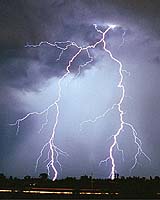
Huntsville AL (SPX) Sep 14, 2006 Here's something fun to try in your kitchen: Go to the freezer, open the door and pry loose an ice cube. Next, look around the freezing compartment for some frost-the crystalline fuzz that loves to coat your frozen English peas. Found it? Rub the ice cube gently across the frost. Nothing happens. Well, what did you expect, a bolt of lightning? Actually, that's just how lightning gets started. Miles above Earth in cumulonimbus clouds, tiny ice crystals are constantly bumping against larger ice pellets. The two kinds of ice rubbing together act like socks rubbing against carpet. Zap! Before you know it, the cloud is crackling with electric potential-and a bolt of lightning explodes to the ground. It may seem hard to believe that a powerful bolt of lightning, which heats the air in its path three times hotter than the surface of the sun, could spring from little pieces of ice. But that's how it is, according to theory, and indeed laboratory experiments have confirmed that you can generate electricity from ice-ice collisions. Still, it does sound fantastic. So, "we decided to check it out," says Walt Petersen, a lightning researcher at the National Space Science and Technology Center in Huntsville, Alabama. Over a three year period, Petersen and his colleagues used the Tropical Rainfall Measurement Mission (TRMM) satellite to look inside more than one million clouds. "TRMM has a radar onboard to measure the amount of ice in a cloud. And it has an optical detector called LIS (lightning imaging sensor) to count lightning flashes." By comparing the ice content of a cloud to its flashes, they could tell if ice and lightning really go together. They do. "We found a strong correlation between ice and lightning in all environments-over land, over sea and in coastal areas." On global scales, the correlation coefficient between lightning "flash density" (flashes per square-kilometer per month) and "ice water path" (kilograms of ice per square-meter of cloud) exceeded 90%. Even stronger correlations were found on the smaller scale of individual storm cells where, for example, about 10 million kilograms of ice would produce one lightning flash per minute. 10 million kilograms. No wonder you couldn't get a spark going in your freezer. A great deal more ice is required to make lightning. In a real thundercloud, millions of pieces of ice are constantly bumping together, pushed by updrafts ranging in speed from 10 to 100 mph. Tiny ice crystals become positively charged and waft to the top of the cloud, while bulkier ice pellets (called "graupel") become negatively charged and plummet to the bottom. This separation creates mega-volts of electrical tension--and hence the lightning. Now that the correlation between ice and lightning is so well established, it can be put to good use. Petersen explains: "Computer programs we write to predict weather and climate need to know how much ice is in clouds. The problem is, ice is hard to track. We can't station a radar over every thundercloud to measure its ice content. To improve our computer forecasts, we need to know where the ice is." Lightning can help. "Because there's such a strong correlation between lightning and ice, we can get a good idea of how much ice is 'up there' by counting lightning flashes." Sensors like LIS, which are inexpensive and can be stationed on the ground as well as in Earth orbit, make this easy to do. Back to your freezer: You might want do something about those English peas. A complete account of Petersen's research may be found in the proceedings of the LIS International Workshop, being held this week in Huntsville, Alabama. Community Email This Article Comment On This Article Related Links LIS International Workshop Weather News at TerraDaily.com Weather News at TerraDaily.com
 First Global Connection Between Earth And Space Weather Found
 Berkeley CA (SPX) Sep 13, 2006
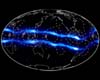
Weather on Earth has a surprising connection to space weather occurring high in the electrically-charged upper atmosphere, known as the ionosphere, according to new results from NASA satellites. |
|
|

| The content herein, unless otherwise known to be public domain, are Copyright 1995-2006 - SpaceDaily.AFP and UPI Wire Stories are copyright Agence France-Presse and United Press International. ESA PortalReports are copyright European Space Agency. All NASA sourced material is public domain. Additionalcopyrights may apply in whole or part to other bona fide parties. Advertising does not imply endorsement,agreement or approval of any opinions, statements or information provided by SpaceDaily on any Web page published or hosted by SpaceDaily. Privacy Statement |