|
 |
 |
 |
 |
 |
 |
 |
 |

 |
First Global Connection Between Earth And Space Weather Found
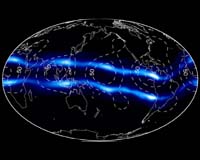
Berkeley CA (SPX) Sep 13, 2006 Weather on Earth has a surprising connection to space weather occurring high in the electrically-charged upper atmosphere, known as the ionosphere, according to new results from NASA satellites. "This discovery will help improve forecasts of turbulence in the ionosphere, which can disrupt radio transmissions and the reception of signals from the Global Positioning System," said Thomas Immel of the University of California, Berkeley, lead author of a paper on the research published August 11 in Geophysical Research Letters. Researchers discovered that tides of air generated by intense thunderstorm activity over South America, Africa and Southeast Asia were altering the structure of the ionosphere. The ionosphere is formed by solar X-rays and ultraviolet light, which break apart atoms and molecules in the upper atmosphere, creating a layer of electrically-charged gas known as plasma. The densest part of the ionosphere forms two bands of plasma close to the equator at a height of almost 250 miles. From March 20 to April 20, 2002, sensors on board NASA's Imager for Magnetopause to Aurora Global Exploration (IMAGE) satellite recorded these bands, which glow in ultraviolet light. Using pictures from IMAGE, the team discovered four pairs of bright regions where the ionosphere was almost twice as dense as the average. Three of the bright pairs were located over tropical rainforests with lots of thunderstorm activity -- the Amazon Basin in South America, the Congo Basin in Africa, and Indonesia. A fourth pair appeared over the Pacific Ocean. Researchers confirmed that the thunderstorms over the three tropical rainforest regions produce tides of air in our atmosphere using a computer simulation developed by the National Center for Atmospheric Research, Boulder, Colo., called the Global Scale Wave Model. The connection to plasma bands in the ionosphere surprised scientists at first because these tides from the thunderstorms can not affect the ionosphere directly. The gas in the ionosphere is simply too thin. Earth's gravity keeps most of the atmosphere close to the surface. Thunderstorms develop in the lower atmosphere, or troposphere, which extends almost 10 miles above the equator. The gas in the plasma bands is about 10 billion times less dense than in the troposphere. The tide needs to collide with atoms in the atmosphere above to propagate, but the ionosphere where the plasma bands form is so thin, atoms rarely collide there. However, the researchers discovered the tides could affect the plasma bands indirectly by modifying a layer of the atmosphere below the bands that shapes them. Below the plasma bands, a layer of the ionosphere called the E-layer becomes partially electrified during the day. This region creates the plasma bands above it when high-altitude winds blow plasma in the E-layer across the Earth's magnetic field. Since plasma is electrically charged, its motion across the Earth's magnetic field acts like a generator, creating an electric field. This electric field shapes the plasma above into the two bands. Anything that would change the motion of the E-layer plasma would also change the electric fields they generate, which would then reshape the plasma bands above. The Global Scale Wave Model indicated the tides should dump their energy about 62 to 75 miles above the Earth in the E-layer. This disrupts the plasma currents there, which alters the electric fields and creates dense, bright zones in the plasma bands above. "The single pair of bright zones over the Pacific Ocean that is not associated with strong thunderstorm activity shows the disruption is propagating around the Earth, making this the first global effect on space weather from surface weather that's been identified," said Immel. "We now know that accurate predictions of ionospheric disturbances have to incorporate this effect from tropical weather." "This discovery has immediate implications for space weather, identifying four sectors on the Earth where space storms may produce greater ionospheric disturbances. North America is in one of these sectors, which may help explain why the U.S. suffers uniquely extreme ionospheric conditions during space weather events," Immel said. Measurements made by NASA's Thermosphere Ionosphere Mesosphere Energetics and Dynamics (TIMED) satellite from March 20 to April 20, 2002, have confirmed that the dense zones exist in the plasma bands. Researchers now want to understand whether the effect changes with seasons or large events, like hurricanes. The research was funded by NASA. The National Center for Atmospheric Research is sponsored by the National Science Foundation, Arlington, Va. The team includes Immel, Scott England, Stephen Mende, and Harald Frey of the University of California, Berkeley; Eiichi Sagawa of the National Institute of Information and Communications Technology, Tokyo, Japan; Sid Henderson and Charles Swenson of Utah State University, Logan, Utah; Maura Hagan of the National Center for Atmospheric Research High Altitude Observatory, Boulder, Colo.; and Larry Paxton of the Johns Hopkins University Applied Physics Laboratory, Laurel, Md. Community Email This Article Comment On This Article Related Links Weather News at TerraDaily.com Learn about Climate Science at TerraDaily.com Weather News at TerraDaily.com
 Hot Dust And Moisture Collide To Fuel Asian Summer Rainy Season
 Greenbelt MD (SPX) Sep 08, 2006
Who would think that something like dust in the air could trigger rain? According to a new NASA study, this is just what's happening over South Asia's Tibetan Plateau. Very small dust particles called aerosols blow in from desert regions and collect in the atmosphere over the plateau's slopes early in the region's monsoon season, helping trigger rainfall. |
|
|

| The content herein, unless otherwise known to be public domain, are Copyright 1995-2006 - SpaceDaily.AFP and UPI Wire Stories are copyright Agence France-Presse and United Press International. ESA PortalReports are copyright European Space Agency. All NASA sourced material is public domain. Additionalcopyrights may apply in whole or part to other bona fide parties. Advertising does not imply endorsement,agreement or approval of any opinions, statements or information provided by SpaceDaily on any Web page published or hosted by SpaceDaily. Privacy Statement |