|
 |
 |
 |
 |
 |
 |
 |
 |

 |
ESO Sub-Millimeter Astronomy Fully Underway
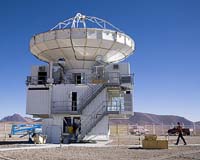
Paranal, Chile (SPX) Jul 20, 2006 ESO has announced that its Atacama Pathfinder Experiment 12-meter sub-millimeter telescope is fully operational and is providing access to the "Cold Universe" with unprecedented sensitivity and image quality. Based on APEX's first observations, astronomers have published 26 articles this week in Astronomy & Astrophysics. Among the many new findings - most in the field of star formation and astrochemistry - are the discovery of a new interstellar molecule, and the detection of light emitted at 0.2 millimeter from carbon monoxide molecules, as well as light coming from a charged molecule composed of two forms of hydrogen. Using both APEX and the IRAM 30-meter telescope, astronomers have made the first astronomical detection of a charged molecule composed of carbon and fluorine - the CF+ ion. Previously, only one fluorine-containing molecular variation had been found in space: the hydrogen-fluoride molecule, consisting of one atom of hydrogen and one of fluorine. The newly discovered molecule, produced through a reaction between carbon and the HF molecule, was found in a region adjoining the Orion nebula, one of the nearest and most active stellar nurseries in the Milky Way. The detection provides support to astronomers' understanding of interstellar fluorine chemistry, suggesting that hydrogen fluoride is ubiquitous in interstellar gas clouds. Another new find: the detection - also in the Orion star-forming region - of light emitted by carbon monoxide at a wavelength of 0.2 millimeter. This particular wavelength is very difficult to investigate, ESO explained in its news release, both because the water vapor in Earth's atmosphere attenuates the signal even more severely than elsewhere in the submillimeter range, but also because it is at the limit of the telescope's operating range. The detection of CO at this wavelength, the very shortest accessible from Earth in any of the submillimeter windows, proves the efficiency of APEX. APEX has detected light emitted from charged molecules of hydrogen and deuterium (H2D+) in several cold clouds in the southern sky. The H2D+ ion traces gas so cold - a few degrees above absolute zero - that only a few molecular species have not frozen out onto the surfaces of dust grains. Other highlights APEX include the first observations of atomic carbon in the "Pillars of Creation" region of the Eagle Nebula, also known as Messier 16. APEX performed a sub-millimetre study of a massive hot core, of a high-mass star forming region, as well as of a high velocity outflow coming from a young stellar object. Studies of molecular regions in the dwarf galaxy NGC 6822 and in the starburst galaxy NGC 253 were also done, proving that APEX can also contribute to the exploration of extragalactic objects. Apart from the astronomical studies, other contributions deal with the technical aspects of APEX, such as the telescope itself, its software, its receivers and spectrometers. The latter were developed at the Max Planck Institute for Radioastronomy in Bonn, Germany, and at the Swedish Chalmers University, while the 0.2 mm receiver was developed at the University of Cologne, Germany. The APEX telescope, designed to work at sub-millimeter wavelengths, in the 0.2 mm to 1.5 mm range, successfully passed its science-verification phase in July of last year. Since then, it has been performing regular science observations. APEX is located on the 5,100-meter (16,575-foot) high Chajnantor plateau in the Atacama Desert in Chile, considered the driest place on Earth. It is a collaborative effort between the Max Planck Institute, ESO and Onsala Space Observatory, Sweden. With its precise antenna and large collecting area, APEX provides, at this location, unprecedented access to a whole new domain in astronomical observations, the ESO release said. Millimeter and sub-millimeter astronomy opens possibilities in the study of the first galaxies to have formed in the universe and of the formation processes of stars and planets. It also allows astronomers to study the chemistry and physical conditions of molecular clouds, that are dense regions of gas and dust in which new stars are forming. APEX is the pathfinder to the ALMA project. It is a modified ALMA prototype antenna and is located at the future site of the ALMA observatory. ALMA will consist of a giant array of 12-meter antennas separated by baselines of up to 14 kilometers (8.7 miles) and is expected to start operation gradually by the end of the decade. The Astronomy & Astrophysics special issue (volume 454 no.2 - August I, 2006) on the first APEX results is available in PDF format here Community Email This Article Comment On This Article Related Links APEX ESO archive ESO Space Telescope News and Technology at Skynightly.com
 Dartmouth Proposes Stratospheric Astronomical Airship
 Hanover NH (SPX) Jul 17, 2006
Astronomer Robert A. Fesen of Dartmouth University appreciates NASA's Hubble Space Telescope, which he says has proven to be a terrific astronomical observatory since it was launched in 1990. |
|
|

| The content herein, unless otherwise known to be public domain, are Copyright 1995-2006 - SpaceDaily.AFP and UPI Wire Stories are copyright Agence France-Presse and United Press International. ESA PortalReports are copyright European Space Agency. All NASA sourced material is public domain. Additionalcopyrights may apply in whole or part to other bona fide parties. Advertising does not imply endorsement,agreement or approval of any opinions, statements or information provided by SpaceDaily on any Web page published or hosted by SpaceDaily. Privacy Statement |