|
 |
 |
 |
 |
 |
 |
 |
 |

 |
Dartmouth Proposes Stratospheric Astronomical Airship
Hanover NH (SPX) Jul 17, 2006 Astronomer Robert A. Fesen of Dartmouth University appreciates NASA's Hubble Space Telescope, which he says has proven to be a terrific astronomical observatory since it was launched in 1990. He adds, however, that there may be a vastly cheaper way to obtain nearly as sharp images of stars and galaxies that doesn't require space shuttle flights or teams of astronauts to launch or repair it. Fesen has written a new report advocating the use of newly developed military and telecommunications high altitude, station-keeping vehicles for astronomy. He suggests that the time has come to develop and launch what he calls a "Hubble Junior" by placing a relatively modest-sized telescope on one of these stratospheric platforms to conduct astronomical observations. "A lot of the basic technology exists to make this happen," Fesen said. "High-altitude airships are currently being developed for telecommunications and for the military." He said he wants "people to begin thinking about the possibility of doing first-rate optical science like that done from Hubble, but at stratospheric altitudes like that flown by the U2 airplane and at a cost of a few million dollars rather than a few billion." Six years ago, Fesen and colleagues from NASA, Johns Hopkins University, and the Southwest Research Institute did a feasibility study on this very topic. They determined that it was indeed possible, as long as the payload (the electronics, the mirror for the telescope, and the pointing system) wasn't too heavy. Since then, the technology has greatly advanced, making the notion of using a high-altitude airship for a stratospheric astronomical observatory a real possibility. An airship, Fesen explained, is a propeller-driven balloon. Two blimp-shaped balloons strapped together in catamaran fashion and solar powered could fly at altitudes of 75,000 feet to 85,000 feet, or about twice that of commercial airplanes. A one-half-meter to one-meter telescope mirror (about 20 inches to 40 inches) lofted to these altitudes would place it above more than 95 percent of the Earth's atmosphere, thereby affording nearly razor sharp images of planets, stars, and galaxies. Fesen is a big fan and a user of the Hubble Telescope. Its 2.4-meter mirror captures beautifully sharp images from its 300-mile-from-Earth orbit. But, he says, Hubble Junior, at an altitude of just 85,000 feet (16 miles), which would place it above all clouds and weather that plague Earth-bound telescopes, could acquire nearly as crisp and clear images as Hubble. "A one-meter-mirror telescope Hubble Junior, although not as powerful as the real Hubble, could complement Hubble's contributions to our understanding of the heavens," he said. "And since it would be more nimble because it's closer to home and simpler to operate, a Hubble Junior could react faster to and follow unexpected supernova explosions, close flybys of asteroids, and other transient astronomical events," he added. Fesen presented his paper, a roadmap of where the science is and what the possibilities are, at a conference sponsored by SPIE, the International Society for Optical Engineering in late May. He has since posted his paper online. "What I did was just outline the recipe," he said. "It's now time to start cooking." Community Email This Article Comment On This Article Related Links Paper Online at SPIE Astronomy at Dartmouth Space Telescope News and Technology at Skynightly.com
 Hubble Advanced Camera Back In Business
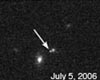 Greenbelt MD (SPX) Jul 14, 2006
After a brief hiatus, the Advanced Camera for Surveys aboard the Hubble Space Telescope is back in full operation, NASA announced Thursday. The instrument is now involved in a quest to understand the nature of the universe's most dominant but mysterious constituent: dark energy. |
|
|

| The content herein, unless otherwise known to be public domain, are Copyright 1995-2006 - SpaceDaily.AFP and UPI Wire Stories are copyright Agence France-Presse and United Press International. ESA PortalReports are copyright European Space Agency. All NASA sourced material is public domain. Additionalcopyrights may apply in whole or part to other bona fide parties. Advertising does not imply endorsement,agreement or approval of any opinions, statements or information provided by SpaceDaily on any Web page published or hosted by SpaceDaily. Privacy Statement |