|
 |
 |
 |
 |
 |
 |
 |
 |

 |
ESA Preparing Its Own Mars Rover
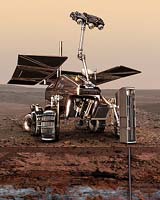
Paris, France (SPX) Jul 12, 2006 As part of ESA's ambitious, long-term Aurora exploration program, ExoMars will search for traces of life on Mars. The mission requires entirely new technologies for self-controlled robots, built-in autonomy and cutting-edge visual terrain sensors. The fourth decade of this century could see Europe participating in a manned mission to Mars in what would be one of humanity's grandest space expeditions ever. Aurora is ESA's attempt to mount a long-term robotic and human exploration of the solar system, with the Moon and then Mars the main targets. A human mission to the red planet would be a major, multi-year undertaking requiring fantastic, entirely new capabilities such as automated cargo vessels, pre-positioned supplies and tools, and communication and navigation satellites in Mars orbit similar to Earth's current GPS systems. Scientists and engineers are already working on ESA's first robotic precursor mission, called ExoMars, and due for launch around 2011. ExoMars will explore the biological environment on Mars in preparation for further robotic and, later, human activity. Data from the mission will also provide invaluable input for broader studies of exobiology - the search for life on other planets. The main element of the mission is a wheeled robotic rover similar in concept to NASA's Mars Exploration Rovers, Spirit and Opportunity, but having different scientific objectives and improved capabilities. The ESA rover will use solar arrays to generate electricity, and will travel over the rocky orange-red surface of Mars, transporting up to 12-kilograms (26 pounds) of scientific payload, including a first-ever lightweight drilling system, as well as a sampling and handling device, and a set of scientific instruments to search for signs of past or present life. Due to distance time-lag and complexity, ExoMars will self-navigate using smart electro-optics to sense and interpret the surrounding terrain autonomously, and it will be capable of operating autonomously using intelligent onboard software. This automated mode of operation is a major advance for ESA, which is long used to controlling spacecraft directly using human specialists. Not only will the rover's onboard control systems be new. "ExoMars will require entirely new techniques and technology for several aspects of the Earth-based rover control system, not just an upgrade of what we have today," said Mike McKay, a senior spacecraft controller and Mars expert based at ESOC, ESA's Spacecraft Operations Center in Darmstadt, Germany. ESA controllers have never before operated a mission that moved about on the surface of another body. The Huygens probe, which touched down successfully on Saturn's giant moon Titan on Jan. 14, 2005, was an atmospheric probe, not a lander - though it functioned briefly after reaching Titan's surface. In one typical example of the rover's autonomous operation, ground controllers might radio up a high-level command telling it to drive to a scientifically interesting spot anywhere from 500 meters to 2,000 meters (1,625 feet to 6,500 feet) away and conduct science operations, such as drilling beneath the surface to sample soil for life signs. The vehicle would handle the details of the move on its own, however. It would survey the ground with a 3D camera, create a digital terrain model, verify its present location, run internal simulations and then make an autonomous decision on the best path to follow, based on obstacles, the rover's current status and risk/resource considerations. "Then it will drive itself to the target. We expect its target accuracy to be within one-half meter over a traverse of 20 meters," said Bob Chesson, head of the Human Spaceflight and Exploration Operations Department in ESA's Operations directorate. As the next generation of robot, ExoMars will profit from lessons learned from the current generation, including NASA's rovers. "We're not shy in trying to learn from the experiences of our sister agencies," Chesson said. Community Email This Article Comment On This Article Related Links Aurora at ESA Mars News and Information at MarsDaily.com Lunar Dreams and more
 Spirit Wintering But Work Continues
 Pasadena CA (SPX) Jul 11, 2006
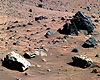
From its winter outpost at Low Ridge inside Gusev Crater, NASA's Spirit rover took this view of the nearby hilly, sandy terrain that includes two potential iron meteorites. The two light-colored, smooth rocks about two-thirds of the way up from the bottom of the frame have been labeled Zhong Shan and Allan Hills. |
|
|

| The content herein, unless otherwise known to be public domain, are Copyright 1995-2006 - SpaceDaily.AFP and UPI Wire Stories are copyright Agence France-Presse and United Press International. ESA PortalReports are copyright European Space Agency. All NASA sourced material is public domain. Additionalcopyrights may apply in whole or part to other bona fide parties. Advertising does not imply endorsement,agreement or approval of any opinions, statements or information provided by SpaceDaily on any Web page published or hosted by SpaceDaily. Privacy Statement |