|
 |
 |
 |
 |
 |
 |
 |
 |

 |
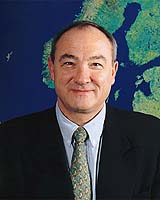
ESA Chief Says Galileo Test Problems Are Being Fixed
Paris (AFP) Jan 17, 2007 European space chief Jean-Jacques Dordain said on Wednesday that problems encountered by a test satellite for the Galileo sat-nav system were being addressed, although he gave no date for its launch. Galileo, touted as a rival to the US Global Positioning system (GPS), plans to have around 30 satellites and be running commercially from 2010. The European Space Agency (ESA) has contracts to launch and test two experimental satellites to confirm Galileo's technology, and also to provide the first four of the 30 satellites. The first satellite, GIOVE-A, successfully launched in December 2005, but its companion, GIOVE-B -- initially scheduled to be hoisted aloft in early 2006 -- has twice been postponed. Dordain, who is ESA's director general, said the delay was "due to a technical problem with a component which failed during tests, but we also encountered organisational problems." "As soon as the problems emerged, we set up three investigative groups, working in parallel. When they reported back, we took technical and organisational action that should enable us to launch GIOVE-B this year." Dordain indicated concern that the flaws with GIOVE B could also be reproduced in the first four Galileo satellites. "We don't want to wait for technical problems to surface in order to take decisions," Dordain, who was speaking to journalists at a New Year's get-together, said. "We want action to be set in place by March enabling IOVE [the four-satellite contract] to move forward properly." Galileo is being promoted as being more accurate than GPS, giving mariners, pilots, drivers and others an almost pinpoint-accurate navigational tool. Unlike GPS, Galileo will stay under civilian control, increasing the European Union's strategic independence. The project has hit other hitches. A contract for ceding operation of Galileo to an eight-member private consortium has still to be signed, and the EU has yet to decide where its overseer, a public body called the Galileo Supervisory Authority, will be sited.
Source: Agence France-Presse Community Email This Article Comment On This Article Related Links ESA GPS Applications, Technology and Suppliers GPS Applications, Technology and Suppliers
 One year of Galileo signals
 Baikonur Cosmodrome, Kazakhstan (SPX) Jan 15, 2007
One year ago GIOVE-A began transmitting Galileo navigation signals. This satellite is the first flight element in ESA's in-orbit validation programme for Galileo. Carried into space from the Baikonur Cosmodrome in Kazakhstan by a Soyuz launch vehicle on 28 December 2005, GIOVE-A then successfully completed the initial tasks in its mission - orbit injection, deployment of its solar arrays and the commissioning and check-out of its various payload systems - before commencing the transmission of navigation signals. |
|
|

| The content herein, unless otherwise known to be public domain, are Copyright 1995-2006 - SpaceDaily.AFP and UPI Wire Stories are copyright Agence France-Presse and United Press International. ESA PortalReports are copyright European Space Agency. All NASA sourced material is public domain. Additionalcopyrights may apply in whole or part to other bona fide parties. Advertising does not imply endorsement,agreement or approval of any opinions, statements or information provided by SpaceDaily on any Web page published or hosted by SpaceDaily. Privacy Statement |