|
 |
 |
 |
 |
 |
 |
 |
 |

 |
Dying Sun-Like Stars Leave Whirlpools In Their Wake
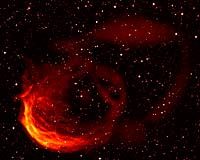
Preston UK (SPX) Apr 17, 2007 Astronomers based at Jodrell Bank Observatory have found evidence that giant whirlpools form in the wake of stars as they move through clouds in interstellar space. The discovery will be presented by Dr Chris Wareing at the Royal Astronomical Society's National Astronomy Meeting in Preston on 17th April. Dr Wareing and his colleagues used the COBRA supercomputer to simulate in three-dimensions the movement of a dying star through surrounding interstellar gas. At the end of their life, Sun-sized stars lose their grip on their outer layers and as much as half of their mass drifts off into space. The computer simulation modelled the collision between material given off by the star and the interstellar gas. It showed that a shockwave forms ahead of the dying star and giant eddies and whirlpools develop in the tail of material behind the star, similar to those seen in the wake of boats on open water. The group have now backed up these predictions with observations of the planetary nebula Sharpless 2-188 taken as part of the IPHAS (Isaac Newton Telescope Photometric H alpha Survey of the Northern Galactic Plane). The central star of Sharpless 2-188 is 850 light years away and it is travelling at 125 kilometres per second across the sky. Observations show a strong brightening in the direction in which the star is moving and faint material stretching away in the opposite direction. Dr Wareing believes that the bright structures in the arc observed ahead of Sharpless 2-188 are the bowshock instabilities revealed in his simulations, which will form whirlpools as they spiral past the star downstream to the tail. "These vortices can improve the mixing of the stellar material back into interstellar space, benefiting the next cycle of star formation. The turbulent whirlpools have an inherent spin, or angular momentum, which is an essential ingredient for the formation of the next generation of stars." Said Dr Wareing who developed the computer model during his PhD and is now using it to understand the fate of our Sun. Dying stars eject both gas and dust into space. The dust will coalesce into planets around later generations of stars. The gas contains carbon, necessary for life and produced inside stars. How the carbon, other gas and dust are ejected from the dying star is not well understood. The whirlpools in space can play an important role in mixing these essential ingredients into the interstellar gas from which further stars and planets will form. IPHAS is a major survey of the Northern Galactic Plane being carried out with the 2.5-metre Isaac Newton Telescope (INT) in La Palma. The IPHAS survey began taking data with the INT Wide Field Camera in 2003 with the goal of imaging the entire northern galactic plane in the latitude range -5 degrees / +5 degrees. Imaging of this 1800 sq. degree area should be completed by the end of 2007. Community Email This Article Comment On This Article Related Links IPHAS RAS Stellar Chemistry, The Universe And All Within It Stellar Chemistry, The Universe And All Within It
 Hotter Than Expected Neutron Star Surfaces Help Explain Superburst Frequency
 East Lansing MI (SPX) Apr 16, 2007
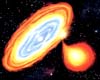
A new theoretical thermometer built from heavy-duty mathematics and computer code suggests that the surfaces of certain neutron stars run significantly hotter than previously expected. Hot enough, in fact, to at least partially answer an open question in astrophysics -- how to explain the observed frequency of ultra-violent explosions known as superbursts that sometimes ignite on such stars' surfaces? |
|
|

| The content herein, unless otherwise known to be public domain, are Copyright 1995-2006 - SpaceDaily.AFP and UPI Wire Stories are copyright Agence France-Presse and United Press International. ESA PortalReports are copyright European Space Agency. All NASA sourced material is public domain. Additionalcopyrights may apply in whole or part to other bona fide parties. Advertising does not imply endorsement,agreement or approval of any opinions, statements or information provided by SpaceDaily on any Web page published or hosted by SpaceDaily. Privacy Statement |