|
 |
 |
 |
 |
 |
 |
 |
 |

 |
Hotter Than Expected Neutron Star Surfaces Help Explain Superburst Frequency
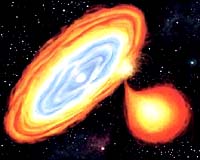
East Lansing MI (SPX) Apr 16, 2007 A new theoretical thermometer built from heavy-duty mathematics and computer code suggests that the surfaces of certain neutron stars run significantly hotter than previously expected. Hot enough, in fact, to at least partially answer an open question in astrophysics -- how to explain the observed frequency of ultra-violent explosions known as superbursts that sometimes ignite on such stars' surfaces? "This is the first model that goes into some reasonable detail about the nuclear physics that occur in the crusts of accreting neutron stars," said Hendrik Schatz, NSCL professor and co-author of a paper that will be published in The Astrophysical Journal in June. One of Schatz's co-authors, NSCL assistant professor Ed Brown, will present the results April 17 at a meeting of the American Physical Society in Jacksonville, Fla. Superbursts emanate from binary systems in which a neutron star orbits a companion star. When the two stars get close enough together, a steady rain of material is sucked away from the companion star onto the surface of the neutron star. Because a neutron star is so dense -- on Earth, one teaspoonful would weigh a billion tons -- the companion star material that reaches the neutron star surface is strongly compressed and heated. Eventually nuclear reactions trigger an explosion that burns through the surface layer of accumulated material, resulting in a burst of X-rays clearly detectable by ground- and space-based instruments. X-ray bursts repeat every few hours to days, along the way fusing hydrogen and helium into a mixture of elements that is itself potentially reactive. In contrast, superbursts occur when, after many months, the accumulated "ashes" produced in the X-ray bursts ignite in a different, even more dramatic nuclear explosion. The result is an outpouring of X-rays some 1,000 times as energetic as a standard X-ray burst. One superburst, which lasts only on the order of a few hours, releases as much energy as the sun will radiate in a decade. Though hardly subtle astrophysical phenomena, superbursts remain shrouded in some mystery, largely because only twelve of the extreme events have ever been observed. This mystery is what attracted the attention of researchers participating in the Joint Institute for Nuclear Astrophysics, or JINA, project. Working with colleagues at Los Alamos National Laboratory and the University of Mainz in Germany, JINA-affiliated NSCL scientists set out to build the most accurate model to-date of the crusts of accreting neutron stars. The team calculated that reactions in the stars' crusts release 10 times more heat than indicated by earlier models. At least in part, this newly discovered heat helps to reconcile the work of theorists and experimentalists who study neutron stars. Prior to Schatz and Brown's research, theoretical astrophysicists predicted that superbursts should occur every ten years or so. Now, according to the new calculation, theorists can explain why the gigantic explosions should occur every three or four years. But more work remains to be done. According to observational data, superbursts occur roughly annually -- and scientists still aren't altogether sure why. "So this doesn't quite solve the problem," Brown said. "It's still an open question as to how nature ignites superbursts." Preprint of forthcoming Astrophysical Journal paper, "Heating in the Accreted Neutron Star Ocean: Implications for Superburst Ignition": http://arxiv.org/abs/astro-ph/0609828; the paper's lead author is former NSCL-JINA postdoc Sanjib Gupta, who now works at Los Alamos. Community Email This Article Comment On This Article Related Links JINA science nugget Michigan State University Stellar Chemistry, The Universe And All Within It Stellar Chemistry, The Universe And All Within It
 Featherweight Celestial Pair Has Uncertain Future Together
 La Serena, Chile (SPX) Apr 11, 2007
Astronomers have serendipitously discovered a record-breaking pair of low-mass stars with an extreme orbital separation. The petite objects, each of which has a mass less than 100 times that of Jupiter, are separated by more than 5,000 times the distance between the Sun and Earth � a value that breaks the previous record by a factor of three and leaves the duration of their future together uncertain. |
|
|

| The content herein, unless otherwise known to be public domain, are Copyright 1995-2006 - SpaceDaily.AFP and UPI Wire Stories are copyright Agence France-Presse and United Press International. ESA PortalReports are copyright European Space Agency. All NASA sourced material is public domain. Additionalcopyrights may apply in whole or part to other bona fide parties. Advertising does not imply endorsement,agreement or approval of any opinions, statements or information provided by SpaceDaily on any Web page published or hosted by SpaceDaily. Privacy Statement |