|
 |
 |
 |
 |
 |
 |
 |
 |

 |
Don Pettit Goes To Antarctica
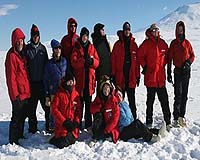
for NASA Science News Huntsville AL (SPX) Dec 15, 2006 Readers of Science@NASA may remember six fun months in 2002-03 when astronaut Don Pettit circled Earth onboard the International Space Station (ISS). Don was the expedition's science officer--and more than that, he was infected with a mischievous sense of experimentation. In the shower, he assembled giant blobs of floating water. He spun them, inflated them with air, and made them vibrate in ways impossible in the water-squashing gravity of Earth. Physicists are still puzzling over some of the things he observed. In the lab, he built a "barn-door tracker" for cameras using odds and ends he found around the station. This device allowed him, essentially, to nullify the 17,000 mph motion of the station in order to take steady photos of cities, aurora borealis, stars and planets. The ISS became Don's personal Hubble. In the kitchen, he demonstrated that High Tea can be taken with chopsticks. Literally, using sticks of wood, he plucked droplets of Russian tea from mid-air and popped them into his mouth. He called these activities (and many others like them) "Saturday Morning Science" because he did most of them in his spare time on Saturday mornings. All were shared with the general public. Now, four years after the ISS, Don is about to serve up a new batch of experiments-this time from Antarctica. He calls them Saturday Morning Science on Ice. "We're on a bit of an adventure," explains Don. "I've joined a scientific expedition to Antarctica to hunt for meteorites. The name of the expedition is ANSMET, short for Antarctic Search for Meteorites, and it is funded by the National Science Foundation and operated by principal investigators from Case Western University. ANSMET has been making annual trips to Antarctica since the mid-70s. The scientific value is immense. More than 10,000 meteorites have been found including such jewels as the famous Allan Hills meteorite from Mars." "I was fortunate enough to be asked to tag along as the token astronaut," he laughs. "Why me? It was mainly dumb luck. One of the ANSMET scientists dropped out at the last minute for medical reasons. Because the principal investigator had dealt with astronauts before, he knew they would not have trouble passing the medical exam and could be called up on short notice. When my boss asked me if I wanted to go, I thought about it for perhaps a nanosecond and said yes!" "So here I am in Antarctica with the ANSMET team looking for little chunks of extra-terrestrial debris that just happened to rain down on the Antarctic continent where the glaciers have this amazing habit of concentrating them well beyond their natural abundance." "There will be some spare time during our search. We'll have tent days, days where the weather is so bad we have to stay in our Scott tents. From past history, this will probably happen one day a week. So what do you do when bad weather confines you to an 8 foot square tent whose basic design has not changed since 1920?" "I plan to continue my Saturday Morning Science that I started on the space station four years ago. I have a microscope, a centrifuge, cameras and other gear for all kinds of scientific investigations." A selected list: Don plans to make a census of microbes in the upper layers of Antarctic ice. He's going to capture and photograph south-polar snowflakes and study their structure. He'll use his centrifuge to separate space dust from melted ice-and so on. The ANSMET team reached the ice fields of Antarctica's Grosvenor Mountains on Dec. 8th and they are busily setting up camp. They'll spend the next six weeks there-plenty of time for discovery. Science@NASA is going to cover the expedition, highlighting Don's new Saturday Morning Science experiments. "So stay tuned," he says, "and see what tantalizing adventures appear on these pages." Community Email This Article Comment On This Article Related Links Beyond the Ice Age Beyond the Ice Age
 Russian Explorers To Cross Arctic Using Amphibian Vehicles
 Moscow (AFP) Dec 14, 2006
A team of Russian explorers will travel 7,000 kilometres (4,350 miles) across the Arctic next year in amphibian vehicles to document the region's history and environment, mission members said Thursday. "It's the most difficult stage" of a project called Polar Ring, expedition leader Vladimir Chukov, a veteran Arctic explorer with a thick grey beard, told a news conference in Moscow. |
|
|

| The content herein, unless otherwise known to be public domain, are Copyright 1995-2006 - SpaceDaily.AFP and UPI Wire Stories are copyright Agence France-Presse and United Press International. ESA PortalReports are copyright European Space Agency. All NASA sourced material is public domain. Additionalcopyrights may apply in whole or part to other bona fide parties. Advertising does not imply endorsement,agreement or approval of any opinions, statements or information provided by SpaceDaily on any Web page published or hosted by SpaceDaily. Privacy Statement |