Energy News  
Russian Explorers To Cross Arctic Using Amphibian Vehicles

Russians Cornered For Two Days By Hungry Polar Bear
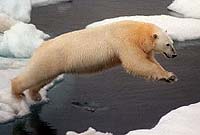
Moscow (AFP) Dec 14 - A group of Russians at an Arctic weather station spent two nerve-wracking days hiding in an attic while waiting for permission from Moscow to shoot a hungry polar bear rampaging through their house, the Izvestia daily reported Thursday. The meteorologists and two gamekeepers were among the latest in Russia's far north-eastern Chukotka region to encounter polar bears stranded by melting ice while following their winter migration routes across the Arctic.

"The hungry bear broke into the weather station, tore apart two dogs and went in to find food in the house," Izvestia reported. The inhabitants "hid in the attic, where they sat two days. They waited until they got permission to shoot the animal, which was given by the environmental ministry in Moscow."

The newspaper reported that about 170 polar bears, which are a protected species, have been stranded along Russia's Arctic shore during unseasonally warm temperatures. "Every year the ice forms later. For example, right now the ice is not thick enough to support the polar bear and the animal is being forced to look for food where people are," Anatoly Kochnyov, an expert with the Pacific Fisheries and Oceanography Scientific Institute, was quoted as saying. Locals in far-flung villages have been warned not to go out at night or to leave their vehicles when traveling, while rubbish tips have been masked with oil to cover the scent, Izvestia said.

by Staff Writers
Moscow (AFP) Dec 14, 2006
A team of Russian explorers will travel 7,000 kilometres (4,350 miles) across the Arctic next year in amphibian vehicles to document the region's history and environment, mission members said Thursday. "It's the most difficult stage" of a project called Polar Ring, expedition leader Vladimir Chukov, a veteran Arctic explorer with a thick grey beard, told a news conference in Moscow.

The expedition, which began in the town of Salekhard in northern Siberia in 2002, aims to complete a tour of the the Arctic in four stages by 2009, taking in Russian, Danish, Canadian and US territory.

The crossing in four vehicles from Russia to Canada via the North Pole is planned for February-June 2007. Expedition members will log the journey on a website, arctic.izvestia.ru, through satellite link-ups.

"The changes to the planet's environment are most visible in the Arctic," said Ilya Freidovich, a scientist who is taking part in the expedition. "These processes, unfortunately, are taking place very quickly and irreversibly," Freidovich said, referring to global warming and the melting ice caps.

He said ice samples would be collected every 30-40 kilometres of the route.

A study published by US scientists this week found that the shrinkage of Arctic sea ice could accelerate dramatically in coming decades, leaving the planet's most northerly ocean virtually devoid of ice in summer by 2040.

But Chukov sounded a more cautious note on the effects of global warming, saying there should be no "panic". Drastic changes in the Arctic environment "won't be felt tomorrow or even in 20 years' time", he said.

A video of the journey so far shows the explorers encountering the remains of a Soviet prison camp, ice caves created in Soviet times to store food reserves in case of war, native reindeer herders, polar bears and cranes.

Source: Agence France-Presse

Community
Email This Article
Comment On This Article

Related Links
Beyond the Ice Age
Beyond the Ice Age


Memory Foam Mattress Review
Newsletters :: SpaceDaily :: SpaceWar :: TerraDaily :: Energy Daily
XML Feeds :: Space News :: Earth News :: War News :: Solar Energy News


NASA Expedition Probes Deep Within A Greenland Glacier
Paris, France (SPX) Dec 14, 2006
Research scientist Dr. Alberto Behar of NASA's Jet Propulsion Laboratory took in the "show" at the moulin this summer. But unlike Paris' famous Moulin Rouge, this moulin had no singers or colorful dancers adorned in feathers, rhinestones and sequins. Rather, the star of this moulin was Mother Nature herself, presenting a dazzling display of moving water and ice.


  • Stripes And Superconductivity - Two Faces of the Same Coin
  • Russian Capabilities Benefit The Hydrogen Economy
  • Ethylene Suggested For Hydrogen Storage
  • South Korea Builds Largest Garbage-Fuelled Power Plant

  • Thorium Poised To Meet World's Energy Needs
  • Bulgaria Signs Contract With Atomstroyexport To Build Nuclear Plant
  • Dwindling Forests And Resources Force Africa To Mull Nuclear Energy
  • Iran Offers To Share Nuclear Know-How With Algeria

  • Climate Change Affecting Outermost Atmosphere Of Earth
  • TIMED Celebrates 5-Year Anniversary
  • Steering Clear Of Icy Skies
  • Increase In Carbon Dioxide Emissions Accelerating

  • Brazil Creates World's Biggest Forest Preserve
  • Report Outlines Funding To Conserve Half Of Massachusetts's Land
  • Trees Reversing Skinhead Earth May Aid Global Climate
  • Danish Christmas Tree Shortage Threatens Prices Across Europe

  • Drought Slashes Australian Wool Production To 20-Year Low
  • Elusive Rust Resistance Genes Located
  • Developing World's Crops Under Increased Threat
  • Rise In California Temperatures Likely To Affect Crops

  • Britain Gets First On-Street Electric Car Chargers
  • Invention Could Solve "Bottleneck" In Developing Pollution-Free Cars
  • 'Hummernator' Schwarzenegger Wants Greener Cars
  • GM Shifts Gears, Makes Push For Electric Cars, More Hybrids

  • Aerospace Manufacturers Meeting The Technology Challenge Of Climate Change
  • German Govt Wants To Cap Airline Carbon Dioxide Emissions
  • Boeing Business Jets Delivers Its 100th Green Airplane
  • A380 Wraps Up Technical Route Proving After a Final Trip Over Both Poles

  • Could NASA Get To Pluto Faster? Space Expert Says Yes - By Thinking Nuclear
  • NASA plans to send new robot to Jupiter
  • Los Alamos Hopes To Lead New Era Of Nuclear Space Tranportion With Jovian Mission
  • Boeing Selects Leader for Nuclear Space Systems Program

  • The content herein, unless otherwise known to be public domain, are Copyright 1995-2006 - SpaceDaily.AFP and UPI Wire Stories are copyright Agence France-Presse and United Press International. ESA PortalReports are copyright European Space Agency. All NASA sourced material is public domain. Additionalcopyrights may apply in whole or part to other bona fide parties. Advertising does not imply endorsement,agreement or approval of any opinions, statements or information provided by SpaceDaily on any Web page published or hosted by SpaceDaily. Privacy Statement