
 |
 |
 |
 |
 |
 |
 |
 |
 |

 |
Dogs of War: Yaargh, here be contractors
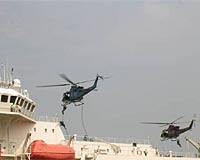
Washington (UPI) Oct 24, 2008 The news that Blackwater Worldwide is offering its services to shippers plagued by pirates -- an issue recently in the headlines, due to the continuing attacks on ships off Somalia -- has set the media twittering about the latest domain to be outsourced to private military contractors. But in reality, this is hardly something new. Though it has not received much attention, private security contractors have been working the maritime beat for many years now, and not just off Africa. In fact, centuries ago the East India Company employed private convoys to protect its ships from pirates. But there is an irony at work here. For if private security contractors are used to fight pirates, it would be a case of contractor vs. contractor. Historically, pirates were some of the first contractors, in that they formed a company, bound by a compact of association, in which the plunder, what we now call profit, is divided according to an agreed convention. In many respects, they were the first corporations. Those wanting to know more should read the article "Pirates, Privateers and the Contract Theories of Hobbes and Locke" in the autumn issue of the History of Political Thought journal, by Peter Hayes, a professor at the United Kingdom's University of Sunderland. And pirates also may have been the first historical example of the sort of credit crunch that the United States and the rest of the world are now experiencing, Hayes notes: In the 17th and 18th century privateers were backed by financiers, much like modern multinational Public Limited Companies, or PLCs. The way that privateering operated back in the golden age of buccaneering is that a group of individuals come together, and agree to kit out a ship to sail the seven seas to see if they can pull in some gold. It was a global gamble for enormous rewards. These predatory voyages are the roots of modern venture capitalism, with these modern multinational corporations out to get all they can get. That's the sort of privateering that led to the credit crunch. And more recently, the maritime industry and the U.S. government have used contractors to help protect ships against pirates and other threats to maritime security. Both the Department of Homeland Security and the U.S. Coast Guard have solicited advice from contractors on matters of maritime security. After the Sept. 11, 2001, attacks a number of British firms -- including Marine Underwater Security Consultants and Hart Security -- were invited to participate in a committee drafting of the U.S. Coast Guard's International Ship and Port Facility code submission to the International Maritime Organization. After the 2000 bombing of the USS Cole, Blackwater was awarded a contract to train more than 50,000 U.S. sailors in the use of small arms to defend their ships from terrorist attacks. Overseas, the U.S. Navy has relied upon Glenn Defense Marine Asia to provide security -- complete with armed Gurkhas -- for its naval vessels while in port. In the wake of the 2002 assault on the French oil tanker Limburg in Yemeni coastal waters, Hart Security was hired to train the Yemeni navy in waterborne anti-terrorist tactics. For years, strategic "choke points" like the Strait of Malacca have been plagued by pirate attacks. To counter that, shippers have turned to firms like Background Asia Risk Solutions to provide armed escorts. Hollow Point Protective Services seeks to prevent pirate and other criminal attacks against clients. Earlier this week John Harris, its CEO, said the firm is "currently in negotiations to provide our asset protection and security services to shipping companies operating in the Gulf of Aden region." And now that the U.S. Navy and its allies have admitted they don't have a big enough fleet to ensure every ship's safety, the demand for contractors will only increase. Of course, it is far from clear that every contractor offering anti-piracy services is legitimate. In 2005 New York-based Topcat Marine Security signed a two-year deal worth more than $50 million with the Somali Transitional Federal Government to escort ships traveling through Somali waters. But Topcat's legitimacy seemed so dubious that the U.S. Department of State's Bureau of Arms Control issued a cease and desist order. Legally, there are reasons why ship owners turn to private contractors for protection, as opposed to merely arming the crews, even when this might be considered an act of self-defense. For example, the state flags under which ships are registered differ over allowing weapons aboard. Some explicitly prohibit it, some say they don't support it, and others remain neutral. There is also the problem of bringing arms into different ports. Some ports prohibit it completely for merchant vessels, even when they are locked up or in transit. And if actual combat occurs, if it is in a nation's territorial waters, the legalities again will vary from place to place. Self-defense is always an argument, but it is dependent on how the local legal authorities are going to interpret it. And in some countries, if a foreigner kills a citizen, that is not a happy situation to be in. To avoid dealing with those variables, Blackwater's solution is to offer a support vessel that would accompany a ship and deploy helicopters to patrol the area. Essentially, it is defensive escort duty, not hunting down pirates. For anti-piracy operations, the 14-sailor crew would be supplemented with Blackwater security guards and four rigid-hull inflatable boats. With respect to piracy off East Africa, while private contractors are offering themselves as an alternative to naval escorts, others argue that the only real solution is a stable Somalia. A recent briefing paper by the Royal Institute of International Affairs concluded, "The most powerful weapon against piracy will be peace and opportunity in Somalia, coupled with an effective and reliable police force and judiciary." (U.S. Navy veteran David Isenberg is a military affairs analyst. He is an adjunct scholar with the Cato Institute, a correspondent for Asia Times and the author of a forthcoming book "Shadow Force: Private Security Contractors in Iraq." His "Dogs of War" column, analyzing developments in the private security and military sector, appears every Friday.) Community Email This Article Comment On This Article Share This Article With Planet Earth
Related Links Iraq: The first technology war of the 21st century
 Military pact traps Baghdad between US demands and Iranian fears
 Baghdad (AFP) Oct 25, 2008
As the United States and Iraq approach a deal on the future US military presence in the country, Baghdad is trapped between Washington's demands and Tehran's fears about US influence in the region, politicians and analysts say. |
|
|

| The content herein, unless otherwise known to be public domain, are Copyright 1995-2007 - SpaceDaily.AFP and UPI Wire Stories are copyright Agence France-Presse and United Press International. ESA Portal Reports are copyright European Space Agency. All NASA sourced material is public domain. Additional copyrights may apply in whole or part to other bona fide parties. Advertising does not imply endorsement,agreement or approval of any opinions, statements or information provided by SpaceDaily on any Web page published or hosted by SpaceDaily. Privacy Statement |
 del.icio.us
 Digg
Digg Reddit
 YahooMyWeb
 Google
 Facebook