|
 |
 |
 |
 |
 |
 |
 |
 |

 |
Dirty Space And Supernovae
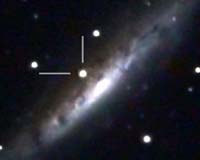
Washington, DC (SPX) Mar 03, 2008 Interstellar space may be strewn with tiny whiskers of carbon, dimming the light of far-away objects. This discovery by scientists at the Carnegie Institution may have implications for the "dark energy" hypothesis, proposed a decade ago in part to explain the unexpected dimness of certain stellar explosions called Type1a supernovae. Type1a supernovae are among the brightest objects in the universe. Astronomers use them as "standard candles" to gauge cosmological distances: brighter-appearing supernovae are closer, dimmer ones are farther away. In the late 1990s some astronomers noticed that some seemed too dim-too far away-to be explained by conventional theories of the universe's expansion. This led to the hypothesis that the expansion was accelerating, pushed along by an unknown form of energy - dark energy. In the current study, published in the February 29 issue of Science, Andrew Steele and Marc Fries of the Carnegie Institution's Geophysical Laboratory report the discovery of an unusual new form of carbon in minerals within meteorites dating from the formation of the solar system. These "graphite whiskers" were likely produced from carbon-rich gas at high temperatures and were found within features called calcium-aluminum inclusions, which at around 4.5 billion years old are the oldest known solids in our solar system. "During this time when the sun was young, the solar wind was very strong," says Fries. "So graphite whiskers formed near the sun could have been blown into interstellar space. The same thing may have happened around other young stars as well." Graphite whiskers might also be produced and dispersed into space by supernovae explosions. A thin interstellar haze of graphite whiskers spewed from stars and supernovae would affect how different wavelengths of light pass through space. It has been postulated that wavelengths in the near infrared would be particularly affected. It is the dimming of light from Type 1a supernovae at these wavelengths that first led researchers to think that the universe's expansion was accelerating and that therefore a hitherto unknown force "dark energy"must exist. However, since the 1970s it has been postulated that graphite or other whisker-like materials could explain the observations. The presence of graphite whiskers in space has never been confirmed until this study. With the discovery of graphite whiskers in the meteorite, researchers can test their properties against the cosmological models and astronomical observations. "If graphite whiskers in space are absorbing supernovae's light," says Steele, "then this could affect measurements of the rate of the universe's expansion. While we cannot comment further on the effects of whiskers on the dark energy hypothesis it is important to study the characteristics of this form of carbon carefully so we can understand its impact on dark energy models. We'll then feed this data forward to the upcoming NASA and ESA (European Space Agency) missions that will look for the effects of dark energy." Community Email This Article Comment On This Article Related Links Carnegie Institution Stellar Chemistry, The Universe And All Within It
 Small Helper Stars Needed For Massive Star Formation
 Berkeley CA (SPX) Mar 03, 2008
In order for a rare, massive star to form inside an interstellar cloud of gas and dust, small "helper" stars about the size of the sun must first set the stage, according to a new theory proposed by astrophysicists at the University of California, Berkeley, and Princeton University. |
|
|

| The content herein, unless otherwise known to be public domain, are Copyright 1995-2007 - SpaceDaily.AFP and UPI Wire Stories are copyright Agence France-Presse and United Press International. ESA Portal Reports are copyright European Space Agency. All NASA sourced material is public domain. Additional copyrights may apply in whole or part to other bona fide parties. Advertising does not imply endorsement,agreement or approval of any opinions, statements or information provided by SpaceDaily on any Web page published or hosted by SpaceDaily. Privacy Statement |