|
 |
 |
 |
 |
 |
 |
 |
 |

 |
Collider Temps Lower Than Outer Space
UPI Correspondent Geneva (UPI) April 10, 2007 The first section of Europe's Large Hadron Collider has reached a temperature of minus 271 degrees Celsius -- lower than that of outer space. The entire 17-mile LHC ring must be cooled to that temperature for its magnets that focus its proton beams to remain in a superconductive state. There are three parts to the cooling process, scientists said, interspersed by many tests. During the first phase, the sector is cooled to minus 193 degrees Celsius -- slightly above the temperature of liquid nitrogen. The second phase brings the temperature to minus 269 degrees Celsius. The final phase cools the magnets to minus 271 degrees Celsius, allowing helium to become superfluid, with virtually no viscosity. "It's exciting because for more than 10 years people have been designing, building and testing separately each part of this sector and now we have a chance to test it all together for the first time," said Serge Claudet, head of the LHC's Cryogenic Operation Team. Although comprising only one-eighth of the LHC, buried beneath the French-Swiss border near Geneva, the sector is the world's largest cryogenic installation.
Source: United Press International Community Email This Article Comment On This Article Related Links Large Hadron Collider Stellar Chemistry, The Universe And All Within It Understanding Time and Space
 Chandra Sees Remarkable Eclipse Of Black Hole
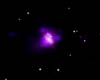 Huntsville, AL (SPX) Apr 13, 2007
A remarkable eclipse of a supermassive black hole and the hot gas disk around it has been observed with NASA's Chandra X-ray Observatory. This eclipse has allowed two key predictions about the effects of supermassive black holes to be tested. |
|
|

| The content herein, unless otherwise known to be public domain, are Copyright 1995-2006 - SpaceDaily.AFP and UPI Wire Stories are copyright Agence France-Presse and United Press International. ESA PortalReports are copyright European Space Agency. All NASA sourced material is public domain. Additionalcopyrights may apply in whole or part to other bona fide parties. Advertising does not imply endorsement,agreement or approval of any opinions, statements or information provided by SpaceDaily on any Web page published or hosted by SpaceDaily. Privacy Statement |