|
 |
 |
 |
 |
 |
 |
 |
 |

 |
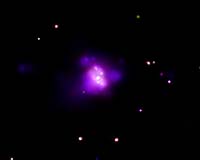
Chandra Sees Remarkable Eclipse Of Black Hole
Huntsville, AL (SPX) Apr 13, 2007 A remarkable eclipse of a supermassive black hole and the hot gas disk around it has been observed with NASA's Chandra X-ray Observatory. This eclipse has allowed two key predictions about the effects of supermassive black holes to be tested. Just as eclipses of the Sun and moon give astronomers rare opportunities to learn about those objects, an alignment in a nearby galaxy has provided a rare opportunity to investigate a supermassive black hole. The supermassive black hole is located in NGC 1365, a galaxy 60 million light years from Earth. It contains a so called active galactic nucleus, or AGN. Scientists believe that the black hole at the center of the AGN is fed by a steady stream of material, presumably in the form of a disk. Material just about to fall into a black hole should be heated to millions of degrees before passing over the event horizon, or point of no return. The disk of gas around the central black hole in NGC 1365 produces copious X-rays but is much too small to resolve directly with a telescope. However, the disk was eclipsed by an intervening cloud, so observation of the time taken for the disk to go in and out of eclipse allowed scientists to estimate the size of the disk. "For years we've been struggling to confirm the size of this X-ray structure," said Guido Risaliti of the Harvard-Smithsonian Center for Astrophysics (CfA) in Cambridge, Mass, and the Italian Institute of Astronomy (INAF). "This serendipitous eclipse enabled us to make this breakthrough." The Chandra team directly measured the size of the X-ray source as about seven times the distance between the Sun and the Earth. That means the source of X-rays is about 2 billion times smaller than the host galaxy and only about 10 times larger than the estimated size of the black hole's event horizon, consistent with theoretical predictions. "Thanks to this eclipse, we were able to probe much closer to the edge of this black hole than anyone has been able to before," said co-author Martin Elvis from CfA. "Material this close in will likely cross the event horizon and disappear from the universe in about a hundred years, a blink of an eye in cosmic terms." In addition to measuring the size of this disk of material, Risaliti and his colleagues were also able to estimate the location of the dense gas cloud that eclipsed the X-ray source and central black hole. The Chandra data show that this cloud is one hundredth of a light year from the black hole's event horizon, or 300 times closer than generally thought. "AGN include the brightest objects in the Universe and are powerful probes of the early universe. So, it's vital to understand their basic structure," said Risaliti. "It turns out that we still have work to do to understand these monsters." A series of six Chandra observations of NGC 1365 were made every two days over a period of two weeks in April 2006. During five of the observations, high energy X-rays from the central X-ray source were visible, but in the second one -- corresponding to the eclipse -- they were not. Community Email This Article Comment On This Article Related Links Chandra at NASA Chandra at Harvard Understanding Time and Space Understanding Time and Space
 Where Has All The Antimatter Gone
 Liverpool UK (SPX) Apr 12, 2007
Scientists from the Universities of Liverpool and Glasgow have completed work on the inner heart of an experiment which seeks to find out what has happened to all the antimatter created at the start of the Universe. Matter and antimatter were created in equal amounts in the Big Bang but somehow the antimatter disappeared resulting in the Universe, and everything in it, including ourselves, being made of the remaining matter. |
|
|

| The content herein, unless otherwise known to be public domain, are Copyright 1995-2006 - SpaceDaily.AFP and UPI Wire Stories are copyright Agence France-Presse and United Press International. ESA PortalReports are copyright European Space Agency. All NASA sourced material is public domain. Additionalcopyrights may apply in whole or part to other bona fide parties. Advertising does not imply endorsement,agreement or approval of any opinions, statements or information provided by SpaceDaily on any Web page published or hosted by SpaceDaily. Privacy Statement |