
 |
 |
 |
 |
 |
 |
 |
 |
 |

 |
CoRoT Finds Other Stars With Sun-Like Vibrations
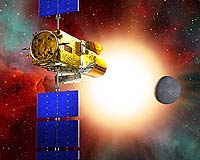
Paris, France (SPX) Oct 27, 2008 CoRoT has unambiguously detected solar-like oscillations in three main sequence stars. All three stars are of main spectral type F, with a significantly higher effective temperature than our Sun. These results are a milestone for the CNES/ESA CoRoT mission and in general for studies of stellar interiors through asteroseismology. The CoRoT (Convection, Rotation and planetary Transits) spacecraft is equipped with a 27-cm diameter telescope and sophisticated instruments capable of highly accurate photometric observations of stars. Variations in the light from these stars can be measured at the level of 10-6. An international team of astronomers led by Eric Michel from the Observatoire de Paris has used the photometric accuracy of CoRoT to obtain detailed light curves of the three stars HD49933, HD181420 and HD181906 in a search for solar-like oscillations.
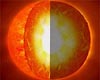
Solar-like oscillations The same convection process also triggers sound waves that travel through the Sun's interior and cause the entire Sun to vibrate at different frequencies or modes. These vibrations result in periodic variations in the Sun's surface temperature and luminosity. Because the frequencies of these waves and their relative amplitudes depend on the interior make up of the Sun, observing them gives valuable information on stellar structure and energy transport within the star. Other stars with masses and luminosities differing from our Sun, but with a similar convective upper layer, are expected to also display these characteristic luminosity variations driven by the convection. These solar-like oscillations have now indeed been found with CoRoT in stars of a type that significantly differs from our Sun's which is a G2V star.
CoRoT results They found and identified the contribution of solar-like oscillations to the variations in the light curve. These variations are caused by the superposition of all solar-like oscillations that are present in the star. To reveal the contributions in light variations at the different oscillation frequencies a Fourier power density spectrum is obtained from each lightcurve (Figure 1). Detailed analysis of the individual frequencies and frequency profiles is ongoing, and in the article Michel and colleagues present already global characteristics of the oscillations. The measure for the maximum amplitude of the solar-like oscillations is found to be higher than in our Sun by a factor of about 1.5 for all three stars. This is 25% smaller then was anticipated from theory for these types of main sequence stars. This finding underpins the value of space-based asteroseismological observations for verifying and refining current models of stellar structure and evolution. Space-based observations are not hindered by Earth's atmosphere and can observe a star for long uninterrupted periods of time. Both these factors allow the required level of accuracy for detecting the minute variations in the star's light to be obtained more easily from space than from ground. Community Email This Article Comment On This Article Share This Article With Planet Earth
Related Links COROT at CNES Solar Science News at SpaceDaily
 Corot Directly Sees Sun-Quakes In Other Stars For First Time
 Paris, France (SPX) Oct 24, 2008
Sounding the Sun through a technique similar to seismology has opened a new era for understanding the Sun's interior. The CNES/ESA COROT satellite has now applied this technique to three stars, directly probing the interiors of stars beyond the Sun for the first time. |
|
|

| The content herein, unless otherwise known to be public domain, are Copyright 1995-2007 - SpaceDaily.AFP and UPI Wire Stories are copyright Agence France-Presse and United Press International. ESA Portal Reports are copyright European Space Agency. All NASA sourced material is public domain. Additional copyrights may apply in whole or part to other bona fide parties. Advertising does not imply endorsement,agreement or approval of any opinions, statements or information provided by SpaceDaily on any Web page published or hosted by SpaceDaily. Privacy Statement |
 del.icio.us
 Digg
Digg Reddit
 YahooMyWeb
 Google
 Facebook