|
 |
 |
 |
 |
 |
 |
 |
 |

 |
Chinese Expected To Travel In Space In 20 Years, Says Official
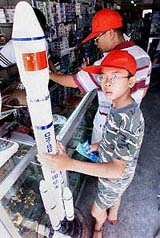
Shanghai (XNA) Nov 04, 2004 The Chinese people "are expected to realize their dream of space travel in 20 years," said a senior official with China's space industry at a symposium Tuesday. Yuan Jiajun, chief commander of China's space program and president of the China Academy of Space Technology, said China will "establish a sound mechanism to commercialize its space technology," which may spur China's manned space flights. He stressed that two fundamental problems should be addressed to bring "a booming space tourism": lowering the cost and ensuring safety. Currently China's research in the space industry mainly serves its national economy and national defense, said Yuan, expressing his belief that in the near future, space technology will be extensively used for civil service and bring more benefits to common people. The development of manned spacecraft in the world may also propel China's space tourism, Yuan added. As an example, Yuan said the successful launch of the first private rocket plane, Space Ship One, designed by Burt Rutan, has reaped some 10 million US dollars for his company. Space Ship One's success is a landmark for the commercialization of manned mission. Space Ship One's journey was simpler than that of spacecrafts in orbit in terms of technology, as it only climbed to a height of 62 miles (100 kilometers), the periphery of outer space, Yuan said. China is scheduled to launch its second manned spacecraft, Shenzhou VI, in 2005, with two Chinese astronauts. The Chinese government also announced its plan to launch a satellite to orbit the moon by 2007 as part of the country's three-stage lunar project. It will be followed by the landing of an unmanned vehicle on the Moon by 2010 and collecting samples of lunar soil with an unmanned vehicle by 2020. Source: Xinhua News Agency Community Email This Article Comment On This Article Related Links SpaceDaily Search SpaceDaily Subscribe To SpaceDaily Express The Chinese Space Program - News, Policy and Technology China News from SinoDaily.com
 Taikonauts On Moon A Far Off Dream For China Yet
 Beijing (XNA) Jan 05, 2006
A one-year lunar fly-by mission may start in April 2007 in China, but a manned flight to the Earth's neighbour may be a long way away, a chief lunar exploration scientist said last night. |
|
|

| The content herein, unless otherwise known to be public domain, are Copyright 1995-2006 - SpaceDaily.AFP and UPI Wire Stories are copyright Agence France-Presse and United Press International. ESA PortalReports are copyright European Space Agency. All NASA sourced material is public domain. Additionalcopyrights may apply in whole or part to other bona fide parties. Advertising does not imply endorsement,agreement or approval of any opinions, statements or information provided by SpaceDaily on any Web page published or hosted by SpaceDaily. Privacy Statement |