|
 |
 |
 |
 |
 |
 |
 |
 |

 |
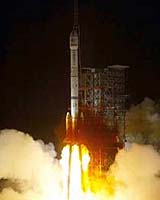
China Launches First Direct Broadcasting Satellite
Beijing (XNA) Oct 30, 2006 China launched a high-power communications and broadcast satellite into orbit on Sunday, continuing its successful programme of launches, state media said. The SinoSat-2 satellite was launched on a Long March 3-B carrier rocket from the Xichang Satellite Launch Centre in southwestern province of Sichuan province at 12.20 am on Sunday (1620 Saturday GMT) and entered its preset orbit 25 minutes later. It is designed to relay television, digital television, live broadcasts and digital broadband multimedia to China, Hong Kong, Macao and Taiwan, the official Xinhua news agency said. SinoSat-2 weighs about 5.1 tonnes and has 22 transponders, with a planned orbital life of 12 years. It was built mainly by the China Academy of Space Technology. The launch was China's 51st consecutive successful space launch since October 1996 and the 93rd launch of a Long March series rocket. The imported SinoSat-1 was launched in July 1998 to broadcast Chinese radio and television signals in the Asia-Pacific region. China plans to launch a SinoSat-3 broadcast satellite next year, the agency said. China has already launched about 50 satellites aboard Long March rockets, which also carried the country's first manned space flight in 2003. Its ambitious space programme includes plans for an orbital moon probe next year and a permanent space laboratory by 2020. The 2003 manned mission made China only the third country to launch an astronaut into space after Russia and the United States.
Source: Xinhua News Agency Community Email This Article Comment On This Article Related Links Read More About the Chinese Space Program The Chinese Space Program - News, Policy and Technology China News from SinoDaily.com
 China Launches Two Space Experiment Satellites
 Taiyuan (XNA) Oct 24, 2006
China successfully launched two satellites for space environment exploration into space with a Long March-4B carrier rocket Tuesday morning. They were launched from the Taiyuan Satellite Launch Center in north China's Shanxi province at 7:34 a.m. Satellite A was detached from the rocket after 11 minutes of take-off, followed by the detachment of Satellite B about one minute later. Both have successfully entered preset orbits. |
|
|

| The content herein, unless otherwise known to be public domain, are Copyright 1995-2006 - SpaceDaily.AFP and UPI Wire Stories are copyright Agence France-Presse and United Press International. ESA PortalReports are copyright European Space Agency. All NASA sourced material is public domain. Additionalcopyrights may apply in whole or part to other bona fide parties. Advertising does not imply endorsement,agreement or approval of any opinions, statements or information provided by SpaceDaily on any Web page published or hosted by SpaceDaily. Privacy Statement |