|
 |
 |
 |
 |
 |
 |
 |
 |

 |
China Issues White Paper On Space Activities
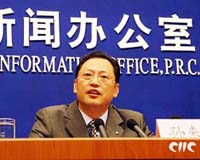
Beijing (XNA) Oct 12, 2006 China on Thursday published a white paper on space activities, illustrating the development of China's space industry over the past five years and its plans for the near future. The 8,500-character white paper, the second of its kind since 2000, is titled "China's Space Activities in 2006" and released by the Information Office of the State Council, China's cabinet. The white paper introduces the aims and principles of China's space development, progress made in the past five years, development targets and major tasks for the next five years, development policies and measures and international exchanges and cooperation. The white paper says it has been 50 "splendid" years since China embarked on the road to develop its space industry, starting in 1956. For half a century, China has made eye-catching achievements, and ranks among the world's most advanced countries in some important fields of space technology. In the new stage of development, China will "center its work on the national strategic goals, strengthen its innovative capabilities and do its best to make the country's space industry develop faster and better," the white paper says. Introducing the major tasks of China's space industry in the coming five years, the white paper says China will give priority to the development of applied satellites and construct a comprehensive chain of space industry covering satellite manufacturing, launching services, ground equipment production and operational services. China will start and implement a high-resolution Earth observation system; develop and launch new-type sun synchronous orbit and geostationary-orbit meteorological satellites, oceanic satellites, Earth resources satellites, small satellites for environmental protection and disaster mitigation monitoring and forecasting. Over the past five years, China has independently developed and launched 22 different types of man-made satellites, upgrading its overall level in this field markedly. China plans to develop nontoxic, pollution-free, high-performance, low-cost and powerful thrust carrier rockets of the new generation in the coming five years, according to the white paper. China aims to increase the carrying capacity of near-Earth orbiters to 25 tons, and that of geostationary orbiters to 14 tons. China will also develop in an overall way the 120-ton thrust liquid-oxygen/kerosene engine and the 50-ton thrust hydrogen-oxygen engine, and increase the reliability and adaptability of the present "Long March" carrier rockets. "Long March" rockets independently developed by China have made24 consecutive successful flights over the past five years, and their major technological functions and reliability have been notably upgraded, says the white paper. China aims to enable astronauts to engage in extravehicular operations and conduct experiments on spacecraft rendezvous and docking, according to the white paper.
Source: Xinhua News Agency Community Email This Article Comment On This Article Related Links Full text: China's Space Activities in 2006 Read More About the Chinese Space Program The Chinese Space Program - News, Policy and Technology China News from SinoDaily.com
 China To Give Priority To Development Of Applied Satellites
 Beijing (XNA) Oct 12, 2006
China will give priority to the development of applied satellites and construct a comprehensive chain of space industry covering satellite manufacturing, launching services, ground equipment production and operational services in the coming five years. |
|
|

| The content herein, unless otherwise known to be public domain, are Copyright 1995-2006 - SpaceDaily.AFP and UPI Wire Stories are copyright Agence France-Presse and United Press International. ESA PortalReports are copyright European Space Agency. All NASA sourced material is public domain. Additionalcopyrights may apply in whole or part to other bona fide parties. Advertising does not imply endorsement,agreement or approval of any opinions, statements or information provided by SpaceDaily on any Web page published or hosted by SpaceDaily. Privacy Statement |