|
 |
 |
 |
 |
 |
 |
 |
 |

 |
Cassini Peeks Below Cloud Shroud Around Titan
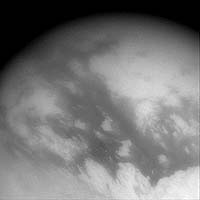
Pasadena CA (JPL) Oct 29, 2004 Early analysis of images and other data captured during last night's close flyby of Saturn's moon Titan by the Cassini spacecraft reveals greater surface detail than ever before and shows that Titan has lost much of its original atmosphere over time. "Titan has incredible diversity," said Dr. Dennis Matson, project scientist for the Cassini-Huygens mission at NASA's Jet Propulsion Laboratory, Pasadena, Calif. "We are glad that we have a full complement of instruments on this spacecraft because it is going to take all of them to reveal the story of Titan." Pictures from the imaging cameras and the visual and infrared mapping spectrometer show a complex interplay between dark and bright material on Titan's surface. The surface appears to have been shaped by multiple geologic processes. Although a few circular features can be seen, none can be definitively identified as impact craters. "We are seeing features and patterns on the surface, and there are processes creating these patterns, and that gives us something to chew on for a while," said Dr. Carolyn Porco, team leader for the imaging team, Space Science Institute, Boulder, Colo. "We can't figure out what the features are, but they are intriguing. This is an environment we have never seen before. It is a very different place and it will take some time to unravel and piece it all together."

|