|
 |
 |
 |
 |
 |
 |
 |
 |

 |
Cassini Finds More Rings Highlighted By Telltale Small Particles
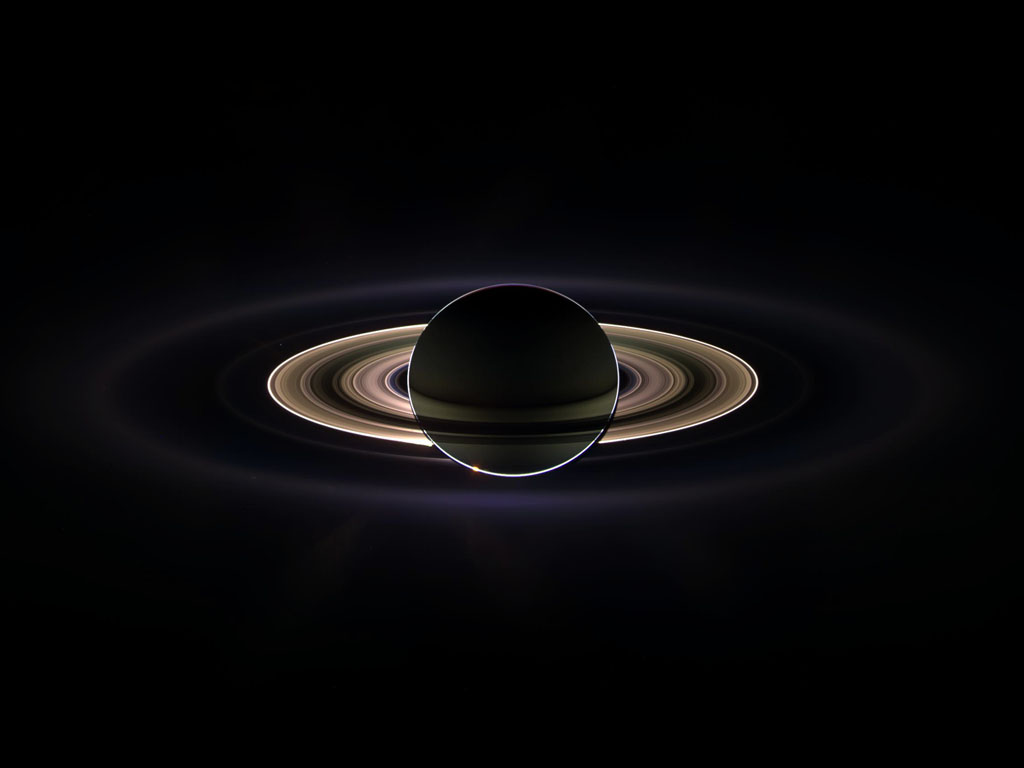
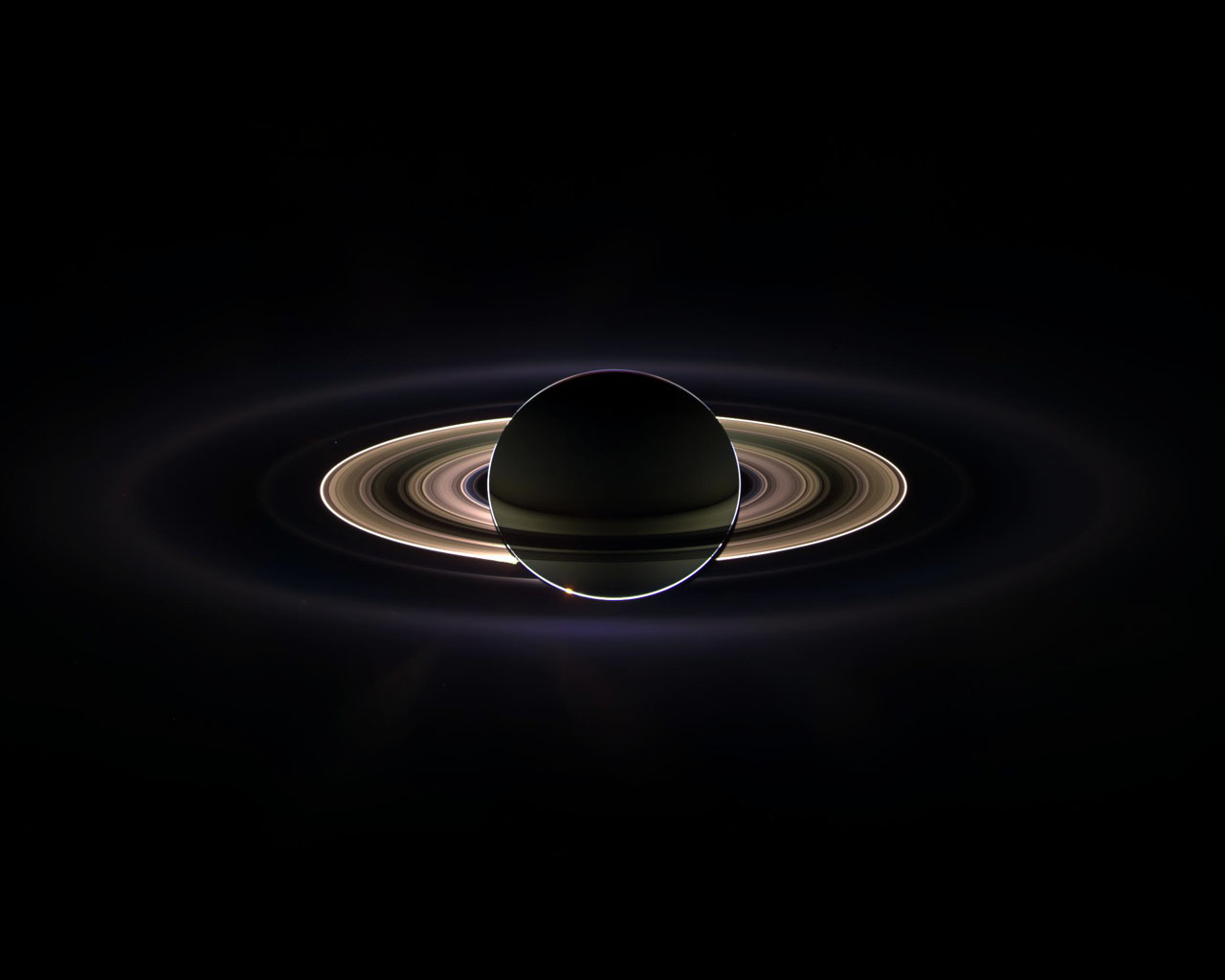
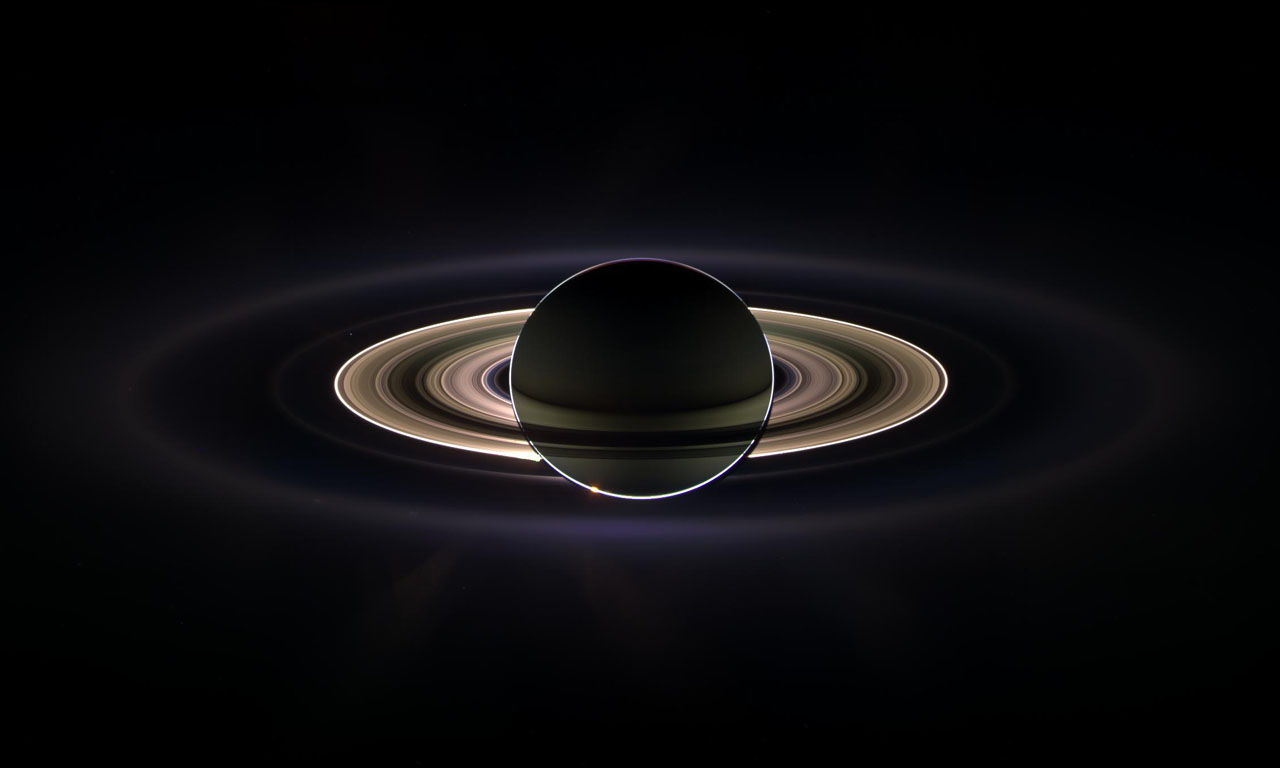
Boulder CO (SPX) Oct 12, 2006 Images taken by NASA's Cassini spacecraft, looking in the direction of the Sun, have provided scientists fresh insights into the dynamic nature of Saturn's rings and, in particular, the creation of new rings made from tiny particles released from larger bodies. Cassini findings are being presented this week at the Division for Planetary Sciences Meeting of the American Astronomical Society held in Pasadena, Calif. - include several new faint ring structures formed by processes acting on and within Saturn's moons and main rings. A series of unique observations gathered in mid-September by NASA's Saturn-orbiting Cassini spacecraft as it drifted slowly through Saturn's shadow, allowed the entire ring system to be seen from a perspective that highlights microscopic ring particles: in many cases, particles only recently released into Saturn orbit. While observing from this locale, Cassini spotted, a single faint new ring, announced previously, in the shared orbit of the moons Janus and Epimetheus. Scientists are now ecstatic to find even more rings. A second new diffuse but narrow ring is coincident with the orbit of the tiny moon Pallene, also discovered by Cassini's imaging cameras and only 4 kilometers (2.5 miles) across. Curiously, another similar-sized moon called Methone, discovered earlier in the mission in roughly the same region, does not seem to sport a ring. A third diffuse ring--the brightest seen in the Cassini Division between the main A and B rings--was also spotted on Sept. 15 from Saturn's shadow. Finally, a faint, very narrow, and seemingly discontinuous ringlet was also found between the broad bands of ring material in the Cassini Division. Though too small to be resolved during the September observations, it too was first seen in images taken in a geometry that enhances the visibility of small particles. "Cassini's superior cameras and close orbits around Saturn allow us to spot fainter and narrower rings than Voyager was able to see", said Dr. Joseph Spitale, an imaging team associate working with team leader Dr. Carolyn Porco. "I wouldn't be surprised if we find more as time goes on." All of these new rings are likely formed and maintained by impacts onto larger bodies, whether moons or large ring particles. These impacts blast material off their surfaces, creating diffuse rings in the same orbit as the parent body. Saturn's diffuse rings are a subset that includes the E, G, and newly discovered rings. Scientists suspect that the G ring is created by impacts into bodies trapped in a remarkably bright arc in the ring. Unlike the other diffuse rings, however, Cassini observations have confirmed that the E ring is created by tiny ice particles spewing from surface jets on the geologically active moon Enceladus. No matter how they are released, small grains are pushed about by sunlight and by electrical forces; hence their distribution tells much about the local space environment. Imaging scientists have also noticed color variations across the diffuse rings that imply active processes sort the particles along the ring according to their sizes. Looking at the faint rings on one side of Saturn, the E ring appears to have a red core with a bluish halo, but the appearance is reversed on the right side--where there is a blue ring interior to a red ring. According to Dr. Matt Hedman, an imaging team associate working at Cornell University in Ithaca, NY, this color variation may imply particles are being sorted by some process according to their sizes. "These tiny grains are like spices--even a little bit of material can alter the ring's character," Hedman said. Additionally, Cassini acquired a movie sequence and other images showing the narrowly confined G ring and its faint arc of material, which is likely held in place by a gravitational resonance with one of Saturn's moons. Imaging Team member Joe Burns, also of Cornell University remarks, "We've been stunned by the rings' variability. Who would have thought, even a few years ago, that we'd see so many new features as the Cassini mission progressed?" Community Email This Article Comment On This Article Related Links Space Science Institute Explore The Ring World of Saturn and her moons Explore The Ring World of Saturn and her moons Jupiter and its Moons The million outer planets of a star called Sol News Flash at Mercury
 Chinese Lantern Technique Helps Track Clouds At Saturn
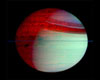 Pasadena CA (SPX) Oct 06, 2006
A new image of Saturn demonstrates a technique that creates a 'Chinese lantern' effect, showing Saturn's deep clouds silhouetted against the planet's warm, glowing interior. Seen this way, Saturn's interior shows surprising activity underneath the overlying haze, with a great variety of cloud shapes and sizes. |
|
|

| The content herein, unless otherwise known to be public domain, are Copyright 1995-2006 - SpaceDaily.AFP and UPI Wire Stories are copyright Agence France-Presse and United Press International. ESA PortalReports are copyright European Space Agency. All NASA sourced material is public domain. Additionalcopyrights may apply in whole or part to other bona fide parties. Advertising does not imply endorsement,agreement or approval of any opinions, statements or information provided by SpaceDaily on any Web page published or hosted by SpaceDaily. Privacy Statement |