|
 |
 |
 |
 |
 |
 |
 |
 |

 |
Canadian Experiment Aboard Space Shuttle Discovery
Longueuil, Canada (SPX) Dec 14, 2006 A unique Canadian experiment on hand-eye coordination capacity of astronauts in microgravity was done yesterday aboard space shuttle Discovery. York University's Dr. Barry Fowler led this experiment funded by the Canadian Space Agency (CSA). Space shuttle pilots and payload operators need quick and accurate hand-eye coordination to manoeuvre objects in space. To dock the shuttle safely to the International Space Station, for example, the pilot must be accurate within a few centimetres while both vehicles move through space at 30,000 km per hour. Manoeuvring a satellite worth tens or hundreds of millions of dollars with the shuttle's Canadarm, or handling a truss weighing close to 20 tons with the Space Station's Canadarm2, are also delicate operations requiring very precise hand-eye coordination. Yet, experience and science experiments have shown that, while in microgravity, astronauts have a harder time reaching and pointing to objects than when they are on Earth. This could be critical in emergency situations. Dr. Fowler is researching the causes of this reduction in hand-eye coordination. To study perceptual-motor deficits in space (PMDIS), he designed an experiment that resembles a simple computer game. " Once the 'why' of perceptual-motor deficits in space is known ", said Dr. Fowler, "we can start looking at how to remedy this problem. This research in space could also lead to new medical knowledge on how the brain adapts or not to disease or injury that can confound hand-eye coordination". Astronaut Sunita Williams, aboard Space Shuttle Discovery (STS-116), was put in front of various situations: in some trials she used a joystick to click on targets appearing on a computer screen, while in others, she tapped with a pointer directly on the touch screen specially designed for this experiment. The difficulty of the task varied with the size of the targets. In other trials that simulate multi-tasking, the astronaut was asked to push a button in response to a tone while hitting targets. Community Email This Article Comment On This Article Related Links Space at Canada Space Station News at Space-Travel.Com Space Shuttle News at Space-Travel.Com Space Shuttle News at Space-Travel.Com
 Discovery Astronauts Begin Spacewalk To Extend ISS
 Houston (AFP) Dec 12, 2006
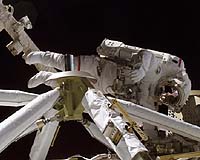
Two Discovery astronauts stepped out into space Tuesday for the first of three spacewalks, to install a new metal structure to the International Space Station, NASA said. Robert Curbeam and Sweeden's first astronaut Christer Fuglesang are expected to spend about six hours in space, a NASA spokesman said. |
|
|

| The content herein, unless otherwise known to be public domain, are Copyright 1995-2006 - SpaceDaily.AFP and UPI Wire Stories are copyright Agence France-Presse and United Press International. ESA PortalReports are copyright European Space Agency. All NASA sourced material is public domain. Additionalcopyrights may apply in whole or part to other bona fide parties. Advertising does not imply endorsement,agreement or approval of any opinions, statements or information provided by SpaceDaily on any Web page published or hosted by SpaceDaily. Privacy Statement |