|
 |
 |
 |
 |
 |
 |
 |
 |

 |
Discovery Astronauts Begin Spacewalk To Extend ISS
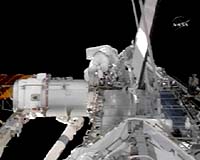
Houston (AFP) Dec 12, 2006 Two Discovery astronauts stepped out into space Tuesday for the first of three spacewalks, to install a new metal structure to the International Space Station, NASA said. Robert Curbeam and Sweeden's first astronaut Christer Fuglesang are expected to spend about six hours in space, a NASA spokesman said. The two will bolt the two-tonne truss segment, called P5 spacer, to the ISS, bringing its total length to 120 meters (394 feet). In a delicate maneuver, the truss is to be guided by the ISS robotic arm, operated by US astronaut Sunita Williams in coordination with Curbeam and Fuglesang, who will bolt the structure in place. The two astronauts will also hook up six cables on the ISS for electricity, commmunications and climate control. Discovery co-pilot Bill Oefelein will direct the heavy construction work in space. Two other spacewalks, scheduled on Thursday and Saturday, are expected to be highly complex because the astronauts will rewire the electricity and climate control of the US-made portion of the ISS from its present, temporary set-up. The work, during which power to half of the ISS will be switched off, includes activating the solar arrays installed by an Atlantis mission in September that will double the present electrical output of the ISS. The Discovery blasted of late Saturday from Cape Canaveral, Florida -- the first nighttime liftoff in four years -- on a 12-day construction mission to the ISS, which NASA expects will be finished by 2010, after another 13 shuttle missions.
Source: Agence France-Presse
related report
Two ESA astronauts meet in space Some 45 hours after launch into the Floridian night sky, NASA's Space Shuttle Discovery came into contact with the forward Pressurized Mating Adapter of the ISS at 23:12 CET (22:12 UT) on 11 December. Following leak checks, the hatches between the two spacecraft were opened nearly two hours later at 00:54 CET (11:54 UT, 11 December) and the ISS crew warmly welcomed their visitors. Among Discovery's seven passengers is Christer Fuglesang, from Sweden, who will spend one week on the ISS under ESA's Celsius Mission, while among the three ISS hosts is Thomas Reiter, from Germany, who has been serving in orbit since his arrival last July, for ESA's Astrolab Mission. One of the very first activities after docking was to remove Thomas Reiter's seat from the Soyuz TMA-9 spacecraft and replace it with another, adapted to the morphology of NASA astronaut Sunita Williams. This event marked the end of Reiter's assignment as ISS Flight Engineer as Sunita Williams takes over this role for the coming six months. Thomas Reiter became part of Discovery's 'descent crew', due to return to Earth on 21 December. ISS assembly continues The primary mission of Discovery's crew is to proceed with the assembly of the ISS. The first of three spacewalks, or extra-vehicular activities (EVAs), is scheduled to start at 21:42 CET (20:42 UT) on Tuesday evening. The main task during this spacewalk is the installation of the P5 integrated truss - a section of the Station's backbone. In preparation for their EVA, astronauts Christer Fuglesang and Robert Curbeam will campout in the Quest airlock on Monday night. In the Quest airlock Fuglesang and Curbeam will breathe pure oxygen to purge their blood from nitrogen before dressing in their spacesuits. This 'pre-breathe' period is required to avoid decompression sickness (commonly known as the 'bends') as they will breathe pure oxygen under a reduced 300-millibar pressure during their spacewalk. This low pressure level prevents the spacesuit from inflating and rigidifying like a balloon in vacuum, which would make it difficult for the astronauts to conduct any task outside the Station.
related report
NASA inspects shuttle wing after possible 'low intensity' impact Two astronauts were using a robotic arm to examine the Discovery's wing leading edge, NASA said. The inspection came after "a sensor has detected an impact (...) of low intensity, last night at 4:30 (1030 GMT) on the left wing of Discovery," NASA television commentator Kyle Herring said. The Discovery, which launched into orbit Saturday, had docked about four hours earlier with the International Space Station.
Source: Agence France-Presse Community Email This Article Comment On This Article Related Links Celsius Mission Space Shuttle News at Space-Travel.Com Space Shuttle News at Space-Travel.Com
 Discovery Docks With Space Station For Tricky Mission
 Houston (AFP) Dec 11, 2006
Shuttle Discovery docked with the International Space Station Monday with a crew of seven astronauts for the most complex ISS construction mission to date. "Welcome aboard," said the commander of the International Space Station (ISS), US astronaut Mike Lopez-Alegria, shortly after the shuttle linked up with the orbiting laboratory at 2212 GMT. |
|
|

| The content herein, unless otherwise known to be public domain, are Copyright 1995-2006 - SpaceDaily.AFP and UPI Wire Stories are copyright Agence France-Presse and United Press International. ESA PortalReports are copyright European Space Agency. All NASA sourced material is public domain. Additionalcopyrights may apply in whole or part to other bona fide parties. Advertising does not imply endorsement,agreement or approval of any opinions, statements or information provided by SpaceDaily on any Web page published or hosted by SpaceDaily. Privacy Statement |