
 |
 |
 |
 |
 |
 |
 |
 |
 |

 |
Caltech Geobiologists Discover Unique Magnetic Death Star Fossil
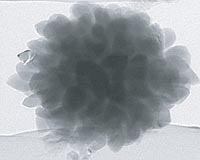
Pasadena CA (SPX) Oct 29, 2008 An international team of scientists has discovered microscopic, magnetic fossils resembling spears and spindles, unlike anything previously seen, among sediment layers deposited during an ancient global-warming event along the Atlantic coastal plain of the United States. The researchers, led by geobiologists from the California Institute of Technology (Caltech) and McGill University, describe the findings in a paper published online this week in the Proceedings of the National Academy of Sciences (PNAS). Fifty-five million years ago, Earth warmed by more than 9 degrees Fahrenheit after huge amounts of carbon entered the atmosphere over a period of just a few thousand years. Although this ancient global-warming episode, known as the Paleocene-Eocene Thermal Maximum (PETM), remains incompletely explained, it might offer analogies for possible global warming in the future. Perhaps in response to the environmental stress of the PETM, many land mammals in North America became dwarfed. Almost half of the common sea bottom-dwelling microorganisms known as foraminifera became extinct in newly warmer waters that were incapable of carrying the levels of dissolved oxygen for which they were adapted. "Imagine our surprise to discover not only a fossil bloom of bacteria that make iron-oxide magnets within their cells, but also an entirely unknown set of organisms that grew magnetic crystals to giant sizes," said Caltech postdoctoral scholar Timothy Raub, who collected the samples from an International Ocean Drilling Program drill-core storehouse at Rutgers University in New Jersey. A typical "giant" spearhead-shaped crystal is only about four microns long, which means that hundreds would fit on the period at the end of this sentence. However, the crystals found recently are eight times larger than the previous world record for the largest bacterial iron-oxide crystal. According to Dirk Schumann, a geologist and electron microscopist at McGill University and lead author of the study, "It was easy to focus on the thousands of other bacterial fossils, but these single, unusual crystals kept appearing in the background. It soon became evident that they were everywhere." In addition to their unusually large sizes, the magnetic crystals occur in a surprising array of shapes. For example, the spearhead-like crystals have a six-sided "stalk" at one end, a bulbous middle, and a sharp, tapered tip at the other end. Once reaching a certain size, spearhead crystals grow longer but not wider, a directed growth pattern that is characteristic of most higher biological organisms. The spearhead magnetic crystals compose a minor fraction of all of the iron-oxide crystals in the PETM clay layer. Most of the crystals have smaller sizes and special shapes, which indicate that they are fossils of magnetotactic bacteria. This group of microorganisms, long studied at Caltech by study coauthor Joseph Kirschvink, the Nico and Marilyn Van Wingen Professor of Geobiology, use magnets to orient themselves within Earth's magnetic field, and proliferate in oxygen-poor water. Spearheads are not, however, the rarest fossil type in the deposit. That honor belongs to a spherical cluster of spearheads informally dubbed the "Magnetic Death Star" by the researchers. The Magnetic Death Star may have preserved the crystals as they occurred in their original biological structure. The researchers could not find a similar-shaped organism anywhere in the paleontological annals. They hypothesize that it may have been a single-celled eukaryote that evolved for the first time during the PETM and was outcompeted once the strange climate conditions of that time diminished. Alternatively, it may still exist today in a currently undiscovered location. "The continental shelf of the mid-Atlantic states during the PETM must have been very iron-rich, much like the Amazon shelf today," notes study coauthor Robert Kopp of Princeton University, who first started working on the project while a graduate student at Caltech. "These fossils may be telling a story of radical environmental transformation: imagine a river like the Amazon flowing at least occasionally where the Potomac is today." The paper, "Gigantism in unique biogenic magnetite at the Paleocene-Eocene Thermal Maximum," will appear in the early online issue of PNAS the week of October 20. The Caltech work was supported by the NASA Exobiology program. Community Email This Article Comment On This Article Share This Article With Planet Earth
Related Links California Institute of Technology (Caltech) Climate Science News - Modeling, Mitigation Adaptation
 Effects Of Climate Change Vary Greatly Across Plant Families
 Boston MA (SPX) Oct 29, 2008
Drawing on records dating back to the journals of Henry David Thoreau, scientists at Harvard University have found that different plant families near Walden Pond have borne the effects of climate change in strikingly different ways. |
|
|

| The content herein, unless otherwise known to be public domain, are Copyright 1995-2007 - SpaceDaily.AFP and UPI Wire Stories are copyright Agence France-Presse and United Press International. ESA Portal Reports are copyright European Space Agency. All NASA sourced material is public domain. Additional copyrights may apply in whole or part to other bona fide parties. Advertising does not imply endorsement,agreement or approval of any opinions, statements or information provided by SpaceDaily on any Web page published or hosted by SpaceDaily. Privacy Statement |
 del.icio.us
 Digg
Digg Reddit
 YahooMyWeb
 Google
 Facebook