|
 |
 |
 |
 |
 |
 |
 |
 |

 |
CU Researchers Shed Light On Light-Emitting Nanodevice
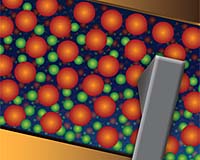
Ithaca NY (SPX) Oct 09, 2007 An interdisciplinary team of Cornell nanotechnology researchers has unraveled some of the fundamental physics of a material that holds promise for light-emitting, flexible semiconductors. The discovery, which involved years of perfecting a technique for building a specific type of light-emitting device, is reported in the Sept. 30 online publication of the journal Nature Materials. The interdisciplinary team had long studied the molecular semiconductor ruthenium tris-bipyridine. For many reasons, including its ability to allow electrons and holes (spaces where electrons were before they moved) to pass through it easily, the material has the potential to be used for flexible light-emitting devices. Sensing, microscopy and flat-panel displays are among its possible applications. The researchers set out to understand the fundamental physics of the material -- that is, what happens when it encounters an electric field, both at the interfaces and inside the film. By fabricating a device out of the ruthenium metal complex that was spin-coated onto an insulating substrate with pre-patterned gold electrodes, the scientists were able to use electron force microscopy to measure directly the electric field of the device. A long-standing question, according to George G. Malliaras, associate professor of materials science and engineering, director of the Cornell NanoScale Science and Technology Facility and one of the co-principal investigators, was whether an electric field, when applied to the material, is concentrated at the interfaces or in the bulk of the film. The researchers discovered that it was at the interfaces -- two gold metal electrodes sandwiching the ruthenium complex film -- which was a huge step forward in knowing how to build and engineer future devices. "So when you apply the electric field, ions in the material move about, and that creates the electric fields at the interfaces," Malliaras explained. Essential to the effort was the ability to pattern the ruthenium complex using photolithography, a technique not normally used with such materials and one that took the researchers more than three years to perfect, using the knowledge of experts in nanofabrication, materials and chemistry. The patterning worked by laying down a gold electrode and a polymer called parylene. By depositing the ruthenium complex on top of the parylene layer and filling in an etched gap between the gold electrodes, the researchers were then able to peel the parylene material off mechanically, leaving a perfect device. Ruthenium tris-bipyridine has energy levels well suited for efficient light emission of about 600 nanometers, said Hector D. Abruna, the E.M. Chamot Professor of Chemistry, and a principal co-investigator. The material, which has interested scientists for many years, is ideal for its stability in multiple states of oxidation, which, in turn, allows it to serve as a good electron and hole transporter. This means that a single-layer device can be made, simplifying the manufacturing process. "It's not fabulous, but it has a reasonable emission efficiency," Abruna said. "One of the drawbacks is it has certain instabilities, but we have managed to mitigate most of them." Among the other authors were co-principal investigators Harold G. Craighead, the C.W. Lake Jr. Professor of Engineering, and John A. Marohn, associate professor of chemistry and chemical biology. Community Email This Article Comment On This Article Related Links Car Technology at SpaceMart.com
 General Motors To Make 250,000 Chevrolets Per Year In Uzbekistan
 Tashkent, Uzbekistan (SPX) Oct 09, 2007
U.S. auto giant General Motors and Korean-Uzbek car manufacturer UzDaewooAvto have set up a joint venture to produce up to 250,000 Chevrolet cars a year in Uzbekistan, company officials said Monday. General Motors will hold 25% plus one share in the new company, with an option to increase its stake in the JV to 40%. |
|
|

| The content herein, unless otherwise known to be public domain, are Copyright 1995-2007 - SpaceDaily.AFP and UPI Wire Stories are copyright Agence France-Presse and United Press International. ESA Portal Reports are copyright European Space Agency. All NASA sourced material is public domain. Additional copyrights may apply in whole or part to other bona fide parties. Advertising does not imply endorsement,agreement or approval of any opinions, statements or information provided by SpaceDaily on any Web page published or hosted by SpaceDaily. Privacy Statement |