|
 |
 |
 |
 |
 |
 |
 |
 |

 |
CALIPSO And CloudSat Get Hoisted For August Launch
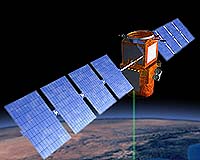
Vandenburg AFB CA (SPX) Jun 21, 2005 The launch of CALIPSO/CloudSat will occur aboard a Boeing Delta II rocket from NASA's Space Launch Complex 2 at VAFB in California, on August 22. The Cloud-Aerosol Lidar and Infrared Pathfinder Satellite Observation (CALIPSO) spacecraft continues to undergo comprehensive checkout, which is scheduled to be completed this week. Atmospheric testing of the spacecraft's laser was completed June 15. CloudSat is undergoing a battery trickle charge. When processing of the satellite resumes June 23, technicians will conduct battery reconditioning and spacecraft fueling. It will then be mated to the lower Dual Payload Attach Fitting. The stacking of the Boeing Delta II at SLC2 began June 14 with the hoisting of the first stage into the launcher. Attachment of the four strap- on solid rocket boosters is under way. The second stage will be hoisted into position June 20. The payload fairing was lifted inside the clean room within the mobile service tower June 13. CALIPSO and CloudSat are highly complementary and together will provide never-before-seen, 3-D perspectives of how clouds and aerosols form, evolve, and affect weather and climate. CALIPSO and CloudSat will fly in formation with three other satellites in the A-train constellation to enable an even greater understanding of our climate system from the broad array of sensors on these other spacecraft. Part of the NASA Earth System Science Pathfinder program, CALIPSO is a collaborative effort with the French space agency Centre National d'Etudes Spatiales (CNES), Ball Aerospace, Hampton University in Virginia and France's Institut Pierre Simon Laplace. Ball Aerospace is responsible for CALIPSO's scientific instrument and communications suite, including the lidar and Wide Field Camera. Community Email This Article Comment On This Article Related Links CALIPSO at NASA SpaceDaily Search SpaceDaily Subscribe To SpaceDaily Express Launch Pad at Space-Travel.com
 Soyuz To Launch Radarsat-2
 Evry, France (SPX) Jan 11, 2006
Starsem announced Monday the signing of a contract with MacDonald, Dettwiler and Associates (MDA) for the launch of MDA's RADARSAT-2 Earth observation satellite by a Soyuz launch vehicle. |
|
|

| The content herein, unless otherwise known to be public domain, are Copyright 1995-2006 - SpaceDaily.AFP and UPI Wire Stories are copyright Agence France-Presse and United Press International. ESA PortalReports are copyright European Space Agency. All NASA sourced material is public domain. Additionalcopyrights may apply in whole or part to other bona fide parties. Advertising does not imply endorsement,agreement or approval of any opinions, statements or information provided by SpaceDaily on any Web page published or hosted by SpaceDaily. Privacy Statement |