|
 |
 |
 |
 |
 |
 |
 |
 |

 |
Busted! Astronomers Nab Culprit In Galactic Hit-and-Run
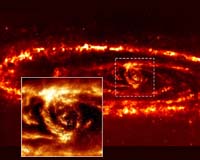
Cambridge MA (SPX) Oct 19, 2006 The Andromeda galaxy, the closest large spiral to the Milky Way, appears calm and tranquil as it wheels through space. But appearances can be deceiving. Astronomers have new evidence that Andromeda was involved in a violent head-on collision with the neighboring dwarf galaxy Messier 32 (M32) more than 200 million years ago. "Like a CSI team, we gathered clues and reconstructed the scene of the crime," said Pauline Barmby (Harvard-Smithsonian Center for Astrophysics), a member of the research group that made the discovery. "The evidence clearly shows that M32 is guilty of committing a hit-and-run." This discovery was reported in the October 19 issue of the journal Nature. Dramatic proof of the galactic smash-up came from images taken by the Infrared Array Camera (IRAC) on NASA's Spitzer Space Telescope. Those images revealed a never-before-seen dust ring deep within the Andromeda galaxy. When combined with a previously observed outer ring, the presence of both dust rings suggests a long-ago disturbance whose effects are still expanding outward through Andromeda. "These dust rings are like ripples in a pond," said David Block (University of the Witwatersrand, Johannesburg), who is the lead author on the paper. "Plop a stone into water and you get an expanding series of rings or waves. Let a small galaxy collide nearly head-on with a larger one, and you will see waves or rings of gas and dust that propagate outward as a result of the violent gravitational interaction. "While our Atlantic Ocean was still forming, Messier 32 plowed head-long into Andromeda's disk of gas and stars," he added. "Only roaming dinosaurs saw the crash and held the secret, until the Spitzer Space Telescope spilled the beans." Research team members Frederic Bournaud and Francoise Combes (Observatoire de Paris) conducted a series of computer simulations to model the collision between Andromeda and M32. They found that M32 plunged through the disk of Andromeda along Andromeda's polar axis approximately 210 million years ago. Since M32 is much less massive than Andromeda, the latter was not substantially disrupted, but the smaller galaxy lost more than half its initial mass in the course of the collision. "To continue the hit-and-run analogy, you could compare M32 to a compact car while Andromeda would be an 18-wheeler," explained Barmby. "In a collision between the two, the truck would be almost unharmed while the car would be wrecked. Similarly, M32 was much more damaged than Andromeda." Astronomers have predicted that Andromeda and the Milky Way will collide in approximately 5 to 10 billion years. That collision will erase the separate identities of each galaxy, leaving a single elliptical galaxy in their place. This discovery was made with Spitzer's Infrared Array Camera, built primarily at NASA Goddard Space Flight Center in Greenbelt, Maryland. The instrument's principal investigator is Giovanni Fazio of CfA. The Jet Propulsion Laboratory, in Pasadena, California, manages the Spitzer Space Telescope mission for NASA's Science Mission Directorate, Washington. Science operations are conducted at the Spitzer Science Center at the California Institute of Technology in Pasadena. Community Email This Article Comment On This Article Related Links Harvard-Smithsonian Center for Astrophysics Stellar Chemistry, The Universe And All Within It Stellar Chemistry, The Universe And All Within It
 Antennae Galaxies Make For A Fertile Marriage In Stellar Chemistry Writ Large
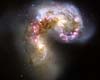 Paris, France (ESA) Oct 18, 2006
A new Hubble image of the Antennae galaxies is the sharpest yet of this merging pair of galaxies. As the two galaxies smash together, thousand of millions of stars are born, mostly in groups and clusters of stars. The Universe is an all-action arena for some of the largest, most slowly evolving and surprising processes known to mankind. |
|
|

| The content herein, unless otherwise known to be public domain, are Copyright 1995-2006 - SpaceDaily.AFP and UPI Wire Stories are copyright Agence France-Presse and United Press International. ESA PortalReports are copyright European Space Agency. All NASA sourced material is public domain. Additionalcopyrights may apply in whole or part to other bona fide parties. Advertising does not imply endorsement,agreement or approval of any opinions, statements or information provided by SpaceDaily on any Web page published or hosted by SpaceDaily. Privacy Statement |