|
 |
 |
 |
 |
 |
 |
 |
 |

 |
Building Shields For Your Starship
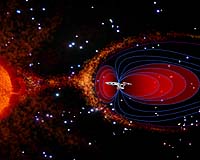
Preston, UK (SPX) Apr 19, 2007 In the last year space agencies in the United States, Europe, China, Japan and India have announced their intention to resume human exploration of the Solar system, beginning with the Moon and perhaps ultimately moving on to Mars. But travel beyond the immediate vicinity of the Earth carries significant risks for astronauts, not the least of which is the exposure to sometimes high levels of radiation. Now a team of scientists at the Rutherford Appleton Laboratory are set to construct an experimental magnetic shield that would protect explorers in their journeys between the planets. Dr Ruth Bamford will present this idea in her talk on Wednesday 18 April at the Royal Astronomical Society National Astronomy Meeting in Preston. Cosmic rays and radiation from the Sun itself can cause acute radiation sickness in astronauts and even death. Between 1968 and 1973, the Apollo astronauts going to the moon were only in space for about 10 days at a time and were simply lucky not to have been in space during a major eruption on the sun that would have flooded their spacecraft with deadly radiation. In retrospect Neil Armstrong's "one small step for Man" would have looked very different if it had. On the International Space Station there is a special thick-walled room to which the astronauts have had to retreat during times of increased solar radiation. However on longer missions the astronauts cannot live within shielded rooms, since such shielding would add significantly to the mass of the spacecraft, making them much more expensive and difficult to launch. It is also now known that the "drip-drip" of even lower levels of radiation can be as dangerous as acute bursts from the sun. On the surface of the Earth we are protected from radiation by the thick layers of the atmosphere. And the terrestrial magnetic field extends far into space, acting as a natural 'force field" to further protect our planet and deflecting the worst of the energetic particles from the Sun by creating a 'plasma barrier". Now scientists at the Rutherford Appleton Laboratory in Oxfordshire plan to mimic nature. They will build a miniature magnetosphere in a laboratory to see if a deflector shield can be used to protect humans living on space craft and in bases on the Moon or Mars. In order to work, an artificial mini-magnetosphere on a space craft will need to utilise many cutting edge technologies, such as superconductors and the magnetic confinement techniques used in nuclear fusion. Thus science is following science fiction once again. The writers of Star Trek realised that any space craft containing humans would need protection from the hazardous effects of cosmic radiation. They envisioned a 'deflector shield" spreading out from the Starship Enterprise that the radiation would bounce off. These experiments will help to establish whether this idea could one day become a practical reality. Community Email This Article Comment On This Article Related Links Rutherford Appleton Laboratory News About Space Exploration Programs Space Tourism, Space Transport and Space Exploration News
 Earth Magnetic Field A Hazard For Lunar Astronauts
 Preston UK (SPX) Apr 17, 2007
For four days every month the Moon passes through the magnetic field of the Earth and parts of the lunar surface are charged with static electricity. Next week Dr Mike Hapgood of the Rutherford Appleton Laboratory will present a model at the Royal Astronomical Society National Astronomy Meeting in Preston, which suggests that this charging may increase after the year 2012 and become an important issue for future lunar explorers. |
|
|

| The content herein, unless otherwise known to be public domain, are Copyright 1995-2006 - SpaceDaily.AFP and UPI Wire Stories are copyright Agence France-Presse and United Press International. ESA PortalReports are copyright European Space Agency. All NASA sourced material is public domain. Additionalcopyrights may apply in whole or part to other bona fide parties. Advertising does not imply endorsement,agreement or approval of any opinions, statements or information provided by SpaceDaily on any Web page published or hosted by SpaceDaily. Privacy Statement |