|
 |
 |
 |
 |
 |
 |
 |
 |

 |
Earth Magnetic Field A Hazard For Lunar Astronauts
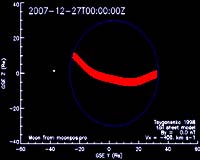
Preston UK (SPX) Apr 17, 2007 For four days every month the Moon passes through the magnetic field of the Earth and parts of the lunar surface are charged with static electricity. Next week Dr Mike Hapgood of the Rutherford Appleton Laboratory will present a model at the Royal Astronomical Society National Astronomy Meeting in Preston, which suggests that this charging may increase after the year 2012 and become an important issue for future lunar explorers. Once in every orbit around the Earth the Moon moves through the magnetic tail - the region on the nightside of the Earth where the magnetic field is drawn out into a million or more kilometre long tail pointing away from the Sun. In the middle of the tail there is a region full of energetic electrons and other charged particles (the plasmasheet). When the Moon passes through the plasmasheet these electrons can collect on parts of the lunar surface and charge them with static electricity. Observations from NASA's Lunar Prospector spacecraft during 1998 confirm the existence of this charging. Dr Hapgood's model suggests that the exposure of the Moon to plasmasheet charging varies markedly over an 18-year cycle linked to changes in the Moon's orbit. This exposure was low at the time of the Apollo landings in the early 1970s and is low again today - but it was high in the 1990s and will rise again after 2012. The United States, Russia, India, Japan and China have all announced plans to send astronauts back to the Moon around the year 2020 - at the time when lunar surface charging is predicted to be high. Lunar surface charging may be an important issue for future lunar exploration because it increases the risk of electric discharges, which can interfere with and damage sensitive electronics. It may also affect the behaviour of lunar dust, which is a recognised hazard for lunar astronauts as it can easily enter spacesuits, living quarters and equipment. Dr Hapgood comments, "Electrical charging is one of the less well-known natural hazards of spaceflight. It's important to understand it how this affects the Moon so spacecraft designers can use scientific knowledge to protect future explorers."
Rutherford Appleton Laboratory Community Email This Article Comment On This Article Related Links News About Space Exploration Programs Space Tourism, Space Transport and Space Exploration News
 Merlin Secures NASA SEWP IV Contract With Potential Value Of Over USD 5 Billion
 Washington DC (SPX) Apr 16, 2007
Merlin International announced that it has secured a contract under the NASA Solutions for Enterprise-Wide Procurement (SEWP) IV Program. The Merlin SEWP IV award is an Indefinite Delivery Indefinite Quantity (IDIQ) Government-Wide Acquisition Contract (GWAC) and has a potential maximum value of $5.6 billion during a seven-year period. The NASA SEWP IV program is the fourth iteration of the original contract vehicle introduced in 1993. |
|
|

| The content herein, unless otherwise known to be public domain, are Copyright 1995-2006 - SpaceDaily.AFP and UPI Wire Stories are copyright Agence France-Presse and United Press International. ESA PortalReports are copyright European Space Agency. All NASA sourced material is public domain. Additionalcopyrights may apply in whole or part to other bona fide parties. Advertising does not imply endorsement,agreement or approval of any opinions, statements or information provided by SpaceDaily on any Web page published or hosted by SpaceDaily. Privacy Statement |