|
 |
 |
 |
 |
 |
 |
 |
 |

 |
Building On Shifting Sands
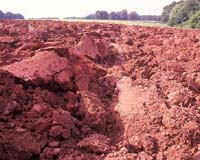
Fargo ND (SPX) Sep 10, 2006 Clay may make a good modeling toy, but it presents challenges for engineers. Clay likes to swell and clay likes to shrink, challenging engineers to build structures on the equivalent of shifting sands. Two North Dakota State University professors have received $209,922 from the National Science Foundation to study these clay-fluid interactions. Dinesh Katti, Ph.D., associate dean of research for the College of Engineering and Architecture; and Kalpana Katti, Ph.D., associate professor of civil engineering at NDSU, will conduct the research. The grant supports a three-year project outlined in their proposal titled "Modeling Effect of Molecular Interactions on Evolution of Microstructure and Swelling and Swelling Pressure Responses in Montmorillonite Expansive Clays." This research will use quantitative computer modeling to understand molecular interactions between clays and fluids and how it impacts engineering properties-since both are critical to design structures and develop solutions to prevent bridges and roads that buckle or buildings that shift or sink. Such factors are also critical to evaluate the feasible use of these materials for environmental engineering and other engineering applications. "These interactions play a critical role in the swelling behavior in expansive clays that causes tremendous damage to infrastructure in the United States and around the world," said Dinesh Katti. "In the United States alone, the annual loss due to these soils is reported to be approximately $7 billion." In the Red River Valley of eastern North Dakota, clays extend more than 100 feet beneath the soil. Structures in the Valley often stand on hundreds of steel pilings or concrete piers driven through the clays until hitting firmer ground. Other areas such as soils of the Mississippi Delta present similar challenges. The Kattis' research is an important step toward the developing micro/nano mechanics of swelling soils. It also quantitatively provides a framework for simulations to study the effect of chemical and biological molecules on swelling and swelling pressure. This will develop innovative and environmentally attractive methods to stabilize swelling clays while retaining good engineering properties, according to Dr. Kalpana Katti. The project will use a combination of techniques to develop multiscale models of clay-fluid interactions. The goal is to develop an approach to bridge molecular level clay-fluid interactions to macroscale response of swelling clays using innovative multiscale modeling. Modeling techniques used include molecular dynamics and discrete element modeling. The computational modeling and simulations will be done on the U.S. TeraGrid supercomputer network and at the NDSU Center for High Performance Computing (CHPC). As part of their research, the Kattis will also develop new educational modules to enhance learning of fundamentals of clay behavior and courses with emphasis on nanoscale and molecular interactions and their effect on macro response in soils. Dr. Kalpana Katti is also a previous recipient of a Faculty Early Career Development award (CAREER) from the National Science Foundation. Community Email This Article Comment On This Article Related Links North Dakota State University Tectonic Science and News
 Team To Drill Below Ocean Earthquake Zone
 Columbia MO (UPI) Aug 30, 2006
Japanese scientists will lead a multi-year international project to place seismographic instruments below the ocean's floor, where earthquakes occur. |
|
|

| The content herein, unless otherwise known to be public domain, are Copyright 1995-2006 - SpaceDaily.AFP and UPI Wire Stories are copyright Agence France-Presse and United Press International. ESA PortalReports are copyright European Space Agency. All NASA sourced material is public domain. Additionalcopyrights may apply in whole or part to other bona fide parties. Advertising does not imply endorsement,agreement or approval of any opinions, statements or information provided by SpaceDaily on any Web page published or hosted by SpaceDaily. Privacy Statement |