|
 |
 |
 |
 |
 |
 |
 |
 |

 |
Bouncing Back From The Brink
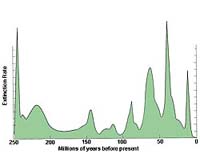
Bristol, UK (SPX) Jan 22, 2008 The full recovery of ecological systems, following the most devastating extinction event of all time, took at least 30 million years, according to new research from the University of Bristol. The finding is helping scientists understand the interactions between past life and the environment of Earth. About 250 million years ago, at the end of the Permian, a major extinction event killed over 90 per cent of life on Earth, including insects, plants, marine animals, amphibians, and reptiles. Ecosystems were destroyed worldwide, communities were restructured and organisms were left struggling to recover. This was the nearest life ever came to being completely wiped out. Previous work indicates that life bounced back quite quickly, but this was mostly in the form of "disaster taxa" (opportunistic organisms that filled the empty ecospace left behind by the extinction), such as the hardy Lystrosaurus, a barrel-chested herbivorous animal, about the size of a pig. The most recent research, conducted by Sarda Sahney and Professor Michael Benton at the University of Bristol and published in Proceedings of the Royal Society B, indicates that specialized animals forming complex ecosystems, with high biodiversity, complex food webs and a variety of niches, took much longer to recover. Sahney and Benton looked at the recovery of tetrapods -- animals with a backbone and four legs, such as amphibians and reptiles -- and found that although globally tetrapods appeared to recover quickly, the dramatic restructuring that occurred at the community level was not permanent and communities did not recover numerically or ecologically until about 30 million years later. Sahney said: "Our research shows that after a major ecological crisis, recovery takes a very long time. So although we have not yet witnessed anything like the level of the extinction that occurred at the end of the Permian, we should nevertheless bear in mind that ecosystems take a very long time to fully recover." Professor Benton explained: "Diversity is most commonly assessed by tallying the number of taxa on a global scale, but these studies are subject to the vagaries of sampling. By examining well-preserved and well-studied faunas, the taxonomic and ecological recovery of communities after the Permian extinction event can be examined more accurately, and the problems of geological bias are largely avoided." The Permian extinctions occurred in three waves, the largest being at the boundary between the Permian and Triassic periods, 251 million years ago. This was the most devastating ecological event of all time, thought to be caused by large-scale volcanism in Russia which produced the "Siberian Traps", covering over 200,000 square kilometers (77,000 square miles) in lava. Community Email This Article Comment On This Article Related Links University of Bristol Darwin Today At TerraDaily.com
 Marsupial Lion Tops African Lion In Fight To Death
 Sydney, Australia (SPX) Jan 18, 2008
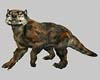
Pound for pound, Australia's extinct marsupial lion (Thylacoleo carnifex) would have made mince meat of today's African lion (Panthera leo) had the two big hyper-carnivores ever squared off in a fight to the death, according to an Australian scientist. New research published in the Journal of Zoology suggests that Thylacoleo killed prey rapidly, using its "bolt-cutter" type teeth to scissor through hide and flesh to produce major trauma and blood loss. |
|
|

| The content herein, unless otherwise known to be public domain, are Copyright 1995-2007 - SpaceDaily.AFP and UPI Wire Stories are copyright Agence France-Presse and United Press International. ESA Portal Reports are copyright European Space Agency. All NASA sourced material is public domain. Additional copyrights may apply in whole or part to other bona fide parties. Advertising does not imply endorsement,agreement or approval of any opinions, statements or information provided by SpaceDaily on any Web page published or hosted by SpaceDaily. Privacy Statement |