|
 |
 |
 |
 |
 |
 |
 |
 |

 |
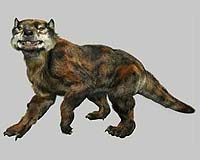
Marsupial Lion Tops African Lion In Fight To Death
Sydney, Australia (SPX) Jan 18, 2008 Pound for pound, Australia's extinct marsupial lion (Thylacoleo carnifex) would have made mince meat of today's African lion (Panthera leo) had the two big hyper-carnivores ever squared off in a fight to the death, according to an Australian scientist. New research published in the Journal of Zoology suggests that Thylacoleo killed prey rapidly, using its "bolt-cutter" type teeth to scissor through hide and flesh to produce major trauma and blood loss. By contrast, African lions and similar big cats of today use their bite force to suffocate prey, using a "clamp and hold" technique that can take up to 15 minutes with large prey such as Cape buffalo. "My results suggest that the marsupial lion employed a unique killing technique," says research author Stephen Wroe. "It used its massive carnassial cheekteeth to effect major trauma and a rapid kill. Unlike any living mammalian carnivores, the marsupial's carnassials were not only butchery tools but also active components in the killing process." Using a sophisticated computer modelling method [finite element (FE) analysis], that renders dynamic 3D models based on CT scans of the marsupial's cranial mechanics and musculoskeletal architecture, Wroe has revealed that the creature's skull, jaw, and head and neck muscles were well adapted to using the unique technique for killing large prey, but not for delivering the prolonged suffocating bite of living big cats. "The marsupial lion also had an extremely efficient bite," Wroe says. "In addition to very powerful jaw muscles for its size, its muscle and skull architecture were arranged in such a way as to take greater advantage of leverage than in living cats." Wroe, who has published findings about bite force in other hypercarnivores, such as great white sharks and sabre tooth tigers, believes there is now no doubt that Australia's marsupial lion was a fearsome predator that punched well above its weight. "Certainly, T carnifex was seriously over-engineered for dispatching small prey. These new findings support the conclusion that the creature regularly preyed on relatively large species and was able to effect quick kills and withstand large forces generated by large struggling prey. "Hypothetically, had a large marsupial lion ever come face to face with an African lion of similar size, it could have use its deadly cheek teeth and incredibly powerful arms to inflict mortal wounds on the mammal," Wroe says. "Had it not become extinct, it might now hold top spot over toady's 'king of the jungle.'" Community Email This Article Comment On This Article Related Links University of New South Wales Darwin Today At TerraDaily.com
 Climate Influence On Deep Sea Populations
 Washington DC (SPX) Jan 17, 2008
In an article published in the January 16 issue of PLoS ONE, Joan B. Company and colleagues at the Institut de Ci�ncies del Mar (CSIC) in Spain describe a mechanism of interaction across ecosystems showing how a climate-driven phenomenon originated in shelf environments controls the biological processes of a deep-sea living resource. |
|
|

| The content herein, unless otherwise known to be public domain, are Copyright 1995-2007 - SpaceDaily.AFP and UPI Wire Stories are copyright Agence France-Presse and United Press International. ESA Portal Reports are copyright European Space Agency. All NASA sourced material is public domain. Additional copyrights may apply in whole or part to other bona fide parties. Advertising does not imply endorsement,agreement or approval of any opinions, statements or information provided by SpaceDaily on any Web page published or hosted by SpaceDaily. Privacy Statement |