|
 |
 |
 |
 |
 |
 |
 |
 |

 |
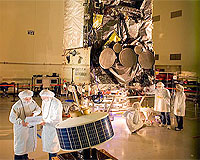
Boeing Satellites Reach 2500 Years Of Accumulated On Orbit Services
St. Louis MO (SPX) Mar 03, 2008 Boeing claims that its more than 260 commercial and civil satellites have achieved a total of 2,500 years of service. Boeing has built one third of the approximately 250 satellites in geosynchronous orbit today. Recent satellites to enter service include DIRECTV 10, Spaceway (broadband Internet), Thuraya 3 (mobile phone service), GOES 13 (weather prediction), and the U.S. Air Force's Wideband Global SATCOM spacecraft (military communications). "When the nightly news warns of an approaching storm, when a car's onboard navigation system provides directions, when a credit card is swiped and approved for credit, and when a warfighter receives mission-critical information, chances are a Boeing satellite is at your service," said Craig Cooning, vice president and general manager of Boeing Space and Intelligence Systems, the unit responsible for the company's communications satellites. "Over the past 45 years, satellite technology has helped to create many new industries, including direct-to-home television, intercontinental cell phone usage, and Internet operations, to name a few. It's unlikely that a day passes when a satellite hasn't touched your life in some way, and Boeing's been there from the start." Boeing's space-based contributions to the world can be traced back to 1963, when the company achieved an industry first with the launch of Syncom, the world's first communications satellite to operate in geosynchronous orbit, 22,300 miles above the equator. Following a theory put forth by inventor and science-fiction writer Arthur C. Clarke, Boeing satellites proved that in that orbit, only three satellites are needed to provide worldwide coverage, compared with more than 50 in a lower orbital position. Boeing today specializes in geosynchronous communications satellites for commercial, civil and military use. New uses for satellite services result from the exponential development of technology. Early satellites required ground-station antennas the size of a small house. The electronics that operated the satellite were also located on the ground, resulting in satellites designed for a single use, without the ability to be reprogrammed for a different mission or service. Contrast this with today's satellites, which carry their "brains" onboard and can communicate to dishes the size of a pencil eraser. Reprogrammable payloads enable operators to change the function of the satellite from one use to another, and phased-array antennas enable operators to adjust the regions that receive the satellite's signal, resulting in instant communications capabilities. The importance of this ability increases during emergencies, catastrophic events or the mobilization of military units. "We maintain a solid satellite backlog in our factory, with 27 today, and we plan to launch at least five satellites in 2008," Cooning said. "In addition, we are aggressively pursuing new business, such as U.S. Air Force's Transformational Communications Satellite system (TSAT) and the next-generation Global Positioning System (GPS III), as well as NASA's next-generation Geostationary Operational Environmental Satellite System (GOES R) and several highly competitive commercial satellite programs. "We are passionate about this technology and about this business, and we are committed to delivering the highest-quality satellites to our customers." Boeing builds these spacecraft at its Satellite Development Center in El Segundo, Calif. Encompassing 1 million square feet, the center is the largest dedicated satellite factory in the world. Its employees monitor all processes to ensure the factory is as Lean as possible. Lean manufacturing increases efficiency and reduces costs, key discriminators for Boeing's satellite competitions. Community Email This Article Comment On This Article Related Links Boeing Space Technology News - Applications and Research
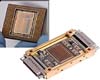
 Amazing Miniaturized SIDECAR Drives Webb Telescope's Signal
 Greenbelt MD (SPX) Feb 22, 2008
Many technologies have become so advanced that they've been miniaturized to take up less space and weigh less. That's what happened to detector controls and data conversion electronics on the James Webb Space Telescope being built by Northrop Grumman. The electronics will convert analog signals to digital signals and provide better images to Earth. |
|
|

| The content herein, unless otherwise known to be public domain, are Copyright 1995-2007 - SpaceDaily.AFP and UPI Wire Stories are copyright Agence France-Presse and United Press International. ESA Portal Reports are copyright European Space Agency. All NASA sourced material is public domain. Additional copyrights may apply in whole or part to other bona fide parties. Advertising does not imply endorsement,agreement or approval of any opinions, statements or information provided by SpaceDaily on any Web page published or hosted by SpaceDaily. Privacy Statement |