|
 |
 |
 |
 |
 |
 |
 |
 |

 |
Boeing Delivers Hardware And Completes Software Testing For GPS
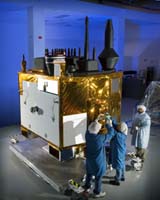
St Louis MO (SPX) Oct 13, 2006 Boeing has announced the delivery of satellite hardware and the completion of new software tests for the next-generation Global Positioning System (GPS). Boeing delivered the first gyroscope package, which helps to stabilize on-orbit spacecraft, for integration on the first GPS Block IIF satellite. The first navigation data unit, which generates the information that users receive from the satellite system, has successfully completed final acceptance testing, while the unit's associated software has completed final qualification testing. Boeing also conducted critical tests of new GPS ground system software. The tests, which put the new distributed systems architecture through rigorous end-to-end operations, verified that the GPS Operational Control Segment (OCS) version 5.2.1 modernized ground system meets or exceeds all GPS performance requirements. OCS controls all on-orbit navigation mission operations up to the point of mission disposal for a constellation that includes 24 operational satellites and four on-orbit spares. "We are working closely with the U.S. Air Force to deliver new, advanced GPS capabilities to the military, civil government and the general public as early as possible," said GPS Program Director John Duddy. "These milestone achievements are another indication of our success in streamlining our production processes and working to build quality into everything we do." Boeing is under contract to upgrade the ground system with new software and hardware in what is considered the largest and most complex event in the 30-year history of the GPS program. The U.S. Air Force Space and Missile Systems Center plans additional software and hardware tests later this year with acceptance expected in early 2007. Boeing is building 12 GPS Block IIF satellites under contract from the Navstar GPS Wing at the Space and Missile Systems Center in Los Angeles, and expects to deliver the first satellite, known as SV-1, in 2007. GPS Block llF is expected to bring new capabilities such as full onboard encrypted military code, a new civil signal known as L-5, crosslink enhancements, signal power increases and greater design life. Boeing also has received a $10 million follow-on contract to further define system requirements for the next-generation GPS Block III system and determine how an enhanced space-based navigation system can address changing military and civilian navigational requirements. Community Email This Article Comment On This Article Related Links GPS Applications, Technology and Suppliers GPS Applications, Technology and Suppliers
 Lockheed Martin And ITT Announce Alliance For GPS 3 Space Segment Competition
 Denver CO (SPX) Oct 12, 2006
Lockheed Martin and ITT Corporation announced Wednesday the formation of a new alliance to compete to build the next generation of Global Positioning System satellites for the U.S. Air Force. Under the teaming agreement, the two companies will build on their existing partnership on the government's Block IIR and IIR-M series in which Lockheed Martin serves as the prime contractor and spacecraft integrator with ITT as the navigation payloads provider. |
|
|

| The content herein, unless otherwise known to be public domain, are Copyright 1995-2006 - SpaceDaily.AFP and UPI Wire Stories are copyright Agence France-Presse and United Press International. ESA PortalReports are copyright European Space Agency. All NASA sourced material is public domain. Additionalcopyrights may apply in whole or part to other bona fide parties. Advertising does not imply endorsement,agreement or approval of any opinions, statements or information provided by SpaceDaily on any Web page published or hosted by SpaceDaily. Privacy Statement |