|
 |
 |
 |
 |
 |
 |
 |
 |

 |
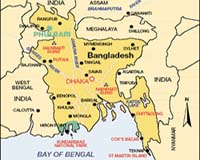
Bangladesh delta is key buffer against global warming, says study
Paris (AFP) Nov 14, 2007 The Bay of Bengal is an unexpected weapon against global warming as it helps store vast quantities of terrestrial carbon brought down by the Ganges-Brahmaputra river systems, a study says. Rivers bring down to the sea carbon in the form of soil and vegetal debris, washed down from slopes, fields and banks. But little is known about what happens to this carbon-rich sediment once it reaches the river's mouth. Some research -- conducted in the churning waters of the Amazon basin -- has suggested that 70 percent of this river-borne organic carbon returns to the atmosphere as gas, thus adding to the greenhouse effect from fossil fuels. But research published on Thursday in the British science journal Nature says the picture is more complex. A team led by Valier Galy of France's Nancy University estimates that around 70-85 percent of the terrestrial carbon that sweeps down the Ganges-Brahmaputra systems from the Himalayas settles to the sea floor rather than escapes to the atmosphere. The reason: high rates of erosion in the Himalayas cause high rates of sedimentation in the so-called Bengal Fan in the Bay of Bengal. Between a billion and two billion tonnes of sediment are transported each year from the Himalayas to the Bengal coast. As a result -- unlike at the mouths of the Amazon -- the thick, fast-growing sediments are not exposed to much oxygen, and this starves microbes of the fuel they need to biodegrade the organic matter. Eventually, powerful currents transfer the sediments to deeper water, where they settle on the ocean bed, safely storing the carbon for potentially millions of years. The finding sheds light on a previously unknown "sink," the term for a natural phenomenon that stores greenhouse gas rather than let it be released into the atmosphere. Sinks thus help cool Earth's surface. By some estimates, around a third of the carbon that falls to the ocean floor is of terrestrial origin (the bulk of the remainder comes from dead plankton). According to Galy's estimates, the Bengal basin is such an efficient burier of carbon that it could account for between 10 and 20 percent of the total terrestrial carbon stored on the ocean bed. In two separate studies, released online by Nature on Wednesday, researchers in the Netherlands and New Zealand say they have identified two hardy species of methane-gobbling bacteria that could also play the role of a "sink." The bugs, which live in the roasting-hot environment of mud volcanoes, were identified at a fumarole near Naples and at Tikitere, or Hell's Gate, in New Zealand. The specialised "methanotrophic" germs, named Acidimethylosilex fumarolicum and Methylokorus infernorum respectively, could play a useful role in mopping up some of the methane burped from Earth's crust, say the authors. Methane is the second biggest greenhouse gas by volume after CO2 but is many times more efficient than CO2 in trapping solar heat. Community Email This Article Comment On This Article Related Links Climate Science News - Modeling, Mitigation Adaptation
 World body warns over ocean 'fertilisation' to fix climate change
 London (AFP) Nov 12, 2007
Countries gathered under an international accord on maritime pollution have warned against offbeat experiments to tackle climate change by sowing the sea with chemicals to help soak up airborne carbon dioxide (CO2). |
|
|

| The content herein, unless otherwise known to be public domain, are Copyright 1995-2007 - SpaceDaily.AFP and UPI Wire Stories are copyright Agence France-Presse and United Press International. ESA Portal Reports are copyright European Space Agency. All NASA sourced material is public domain. Additional copyrights may apply in whole or part to other bona fide parties. Advertising does not imply endorsement,agreement or approval of any opinions, statements or information provided by SpaceDaily on any Web page published or hosted by SpaceDaily. Privacy Statement |