|
 |
 |
 |
 |
 |
 |
 |
 |

 |
World body warns over ocean 'fertilisation' to fix climate change
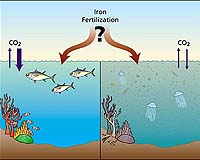
London (AFP) Nov 12, 2007 Countries gathered under an international accord on maritime pollution have warned against offbeat experiments to tackle climate change by sowing the sea with chemicals to help soak up airborne carbon dioxide (CO2). Parties to the London Convention and London Protocol declared that they hold authority over such experiments, and "large-scale operations" of this kind "are currently not justified," according to a statement issued on Monday. Several controversial experiments have been carried out or are being planned to "fertilise" areas of the sea with iron or urea to see whether this encourages the growth of plankton. Much of the CO2 emitted by fossil fuels is dissolved by the sea from the atmosphere. In turn, microscopic marine plants at the sea surface absorb some of the CO2 through photosynthesis. When they die, they fall to the ocean floor, thus potentially storing the carbon for millions of years. Defenders of fertilisation say that carbon pollution is so far out of control that a swift fix is needed to avert catastrophe for the climate system. By accelerating plankton growth, carbon could be massively sucked out of Earth's atmosphere, reducing the warming effect of this greenhouse gas, they argue. But marine biologists and climate scientists say the experiments are hedged with environmental peril, such as the risk that runaway algal growth could starve swathes of the ocean of oxygen. Monday's statement said the London Convention and London Protocol parties agreed a five-point position on ocean fertilisation at their 29th consultative meeting on Friday. They endorsed a "statement of concern" by expert opinion to this panel, and said consideration of ocean fertilisation fell within their purview for protecting the marine environment. The parties urged states "to use the utmost caution when considering proposals for large-scale ocean fertilisation operations," the communique said. "Given the present state of knowledge regarding ocean fertilisation, such large-scale operations are currently not justified." The London Convention and Protocols come under the International Maritime Organisation (IMO). The 1972 London accord, called the "Convention on the Prevention of Marine Pollution by Dumping of Wastes and Other Matter 1972," has 82 signatory states. It was followed in 1996 by a tougher agreement, the London Protocol, under which all dumping is prohibited, except for "possibly acceptable" wastes on the so-called "reverse list". There are are currently 31 Parties to the Protocol. Earlier this year, the UN's Nobel-winning Intergovernmental Panel on Climate Change (IPCC) said that ocean fertilisation and other geo-engineering schemes, such as erecting a giant parasol in orbit to cool the planet, were "largely speculative and with the risk of unknown side effects." In a study published on Sunday by the British journal Nature, scientists confirmed that plankton can suck up far more CO2 than previously realised, but stressed that the damage to the marine ecoystem was unknown. German-led researchers closed off part of Raune fjord in southern Norway to see how plankton reacted to different levels of CO2, simulating emissions levels that likely to prevail over the next 150 years. The organisms were able to gobble up to 39 percent more dissolved carbon compared with today, but did not need any additional nutrients to achieve this. The paper, though, warned that algal blooms could inflict oxygen depletion in some parts of the ocean while rising carbon levels could cause an imbalance in primary nutrients, with implications that could ripple across the marine food web. Environmental groups on Monday called on the Philippine government to stop an Australian company's plan to dump hundreds of tonnes of urea fertiliser into the Sulu Sea, site of the UNESCO World Heritage Tubbataha Reef Marine Park, as an experiment. Community Email This Article Comment On This Article Related Links Climate Science News - Modeling, Mitigation Adaptation
 Groups oppose "ocean fertilisation" in Philippines
 Manila (AFP) Nov 12, 2007
Environmental groups condemned on Monday an Australian company's plan to dump hundreds of tonnes of fertiliser into Philippine waters as part of an experiment to combat climate change. |
|
|

| The content herein, unless otherwise known to be public domain, are Copyright 1995-2007 - SpaceDaily.AFP and UPI Wire Stories are copyright Agence France-Presse and United Press International. ESA Portal Reports are copyright European Space Agency. All NASA sourced material is public domain. Additional copyrights may apply in whole or part to other bona fide parties. Advertising does not imply endorsement,agreement or approval of any opinions, statements or information provided by SpaceDaily on any Web page published or hosted by SpaceDaily. Privacy Statement |