|
 |
 |
 |
 |
 |
 |
 |
 |

 |
B-2S Stay In Shape With Exercises
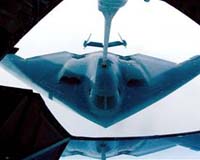
Andersen AFB, Guam (AFNS) Jun 25, 2006 The 393rd Expeditionary Bomb Squadron has spent the past three weeks refining the skills necessary to maintain the B-2 Spirit, one of the world's most advanced weapon systems. During exercises Valiant Shield, continuing through June 23, and Northern Edge, which ran from June 5 to 16, B-2 aircrew members executed long-duration missions and integrated with aircraft they don't typically see on the range. Valiant Shield, conducted on and around Guam, is a U.S. Pacific Command exercise which focuses on integrated joint training and interoperability among U.S. military forces while responding to a range of mission scenarios. The exercise is designed to make sure U.S. forces have a seamlessly integrated environment where they can conduct deterrence-type missions and, if deterrence fails, high-intensity combat operations, said Col. Robert Wheeler, 36th Expeditionary Operations Group commander. "Valiant Shield gives us the opportunity to integrate Air Force global-strike assets with carrier-based seapower in an intense leveraging of firepower," said Maj. Mark Pye, 36th Expeditionary Operations Support Squadron director of operations. As part of the exercise, B-2s are flying consecutive training missions, keeping aircrew members and 36th Expeditionary Aircraft Maintenance Squadron maintainers at a high operations tempo for the majority of the exercise. "The Valiant Shield exercise has maintainers across Andersen Air Force Base very busy fixing and flying aircraft. The B-2 is no different, flying five straight days supporting exercise sortie requirements," said Capt. James Temple, 393rd Aircraft Maintenance Unit officer in charge. "Exercises are always an exciting time to focus our efforts and surge warfighting capability." B-2 aircrew members agree the hard work is worth it because of the long-term benefits of training in a joint environment. "It's a rare opportunity to bring together platforms that normally do not regularly exercise together - Air Force fighters and bombers and Navy carrier strike groups being a good example - to ensure an integrated U.S. air, sea, land, space and cyberspace force capable of an overwhelming and decisive response in any future contingency," said Lt. Col. Paul Tibbets IV, 393rd EBS commander. Before Exercise Valiant Shield, B-2s played a role in Exercise Northern Edge. The joint training exercise hosted by Alaskan Command is one of a series of U.S. Pacific Command exercises preparing joint forces to respond to crises in the Asia-Pacific region. "The B-2s were tasked with multiple roles during their mission, which is not uncommon for us," said Maj. Jeff Schreiner, 393rd EBS assistant director of operations. "These included striking multiple dynamic targets, which were received via long-range communications from the Kenney Headquarters Pacific Air Operations Center shortly before entering Alaska, and these targets included simulated surface-to-air missile sites and simulated enemy troop movements." Exercise Northern Edge required pilots to complete a sortie at a training range approximately 4,500 nautical miles away in Alaska, resulting in a 9,800 nautical-mile round trip lasting more than 24 hours. The exercise also brought the Air Force's two most advanced weapon systems together, as F-22 Raptors from the 27th Fighter Squadron at Langley AFB, Va., joined B-2s during training missions on the Yukon Training Range near Eielson AFB, Alaska. "The B-2s also integrated with F-22s to 'kick down the door' against a simulated enemy integrated air defense anchored by formidable Northern Edge 'enemy' fighters," Major Pye said. "This paved the way for powerful follow-on strike packages to attack enemy maritime and land-based targets at will." "Northern Edge provided a realistic combat environment to implement tactics critical to future B-2 and F-22 operations," said Capt. William Hepler, 393rd EBS, one of the B-2 pilots on the Northern Edge mission. "It was a great opportunity to integrate the capabilities of the B-2 with those of the F-22 and learn more about each aircraft." The B-2 aircraft, aircrew members and support personnel, deployed to Andersen AFB from the 509th Bomb Wing at Whiteman AFB, Mo., provide the U.S. Pacific commander a continuous bomber presence in the Asia-Pacific region. The B-2s are scheduled to remain at Andersen AFB until September. Community Email This Article Comment On This Article Related Links US Pacific Command Military Space News at SpaceWar.com
 Boeing-Led Team Fires Surrogate Lasers From Airborne Laser Aircraft
 St Louis MO (SPX) Jun 27, 2006
A Boeing-led industry team and the U.S. Missile Defense Agency (MDA) took a major step toward demonstrating the capability of the Airborne Laser (ABL) by successfully firing surrogate lasers from inside the aircraft. |
|
|

| The content herein, unless otherwise known to be public domain, are Copyright 1995-2006 - SpaceDaily.AFP and UPI Wire Stories are copyright Agence France-Presse and United Press International. ESA PortalReports are copyright European Space Agency. All NASA sourced material is public domain. Additionalcopyrights may apply in whole or part to other bona fide parties. Advertising does not imply endorsement,agreement or approval of any opinions, statements or information provided by SpaceDaily on any Web page published or hosted by SpaceDaily. Privacy Statement |