|
 |
 |
 |
 |
 |
 |
 |
 |

 |
Boeing-Led Team Fires Surrogate Lasers From Airborne Laser Aircraft
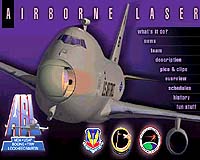
St Louis MO (SPX) Jun 27, 2006 A Boeing-led industry team and the U.S. Missile Defense Agency (MDA) took a major step toward demonstrating the capability of the Airborne Laser (ABL) by successfully firing surrogate lasers from inside the aircraft. During recent ground tests at Boeing facilities in Wichita, Kan., the team placed the lasers in the ABL aircraft, a modified Boeing 747-400F, and fired them repeatedly into a measuring device called a range simulator. The tests verified that the ABL team properly aligned the optical beam train, a series of optical components, steering and deformable mirrors, and sensors that will guide lasers to an actual target. The equipment exercised in the tests is part of the beam control/fire control system designed and integrated by Lockheed Martin. The lasers used in the tests were low-power surrogates for ABL's high-energy laser and two illuminator lasers. The program plans to install actual illuminators in the jet for ground and flight tests later this year. The track illuminator laser is designed to track all classes of hostile ballistic missiles. The beacon illuminator laser will measure atmospheric conditions, allowing the beam control/fire control system to compensate for atmospheric turbulence in the high-energy laser's path to a target. During this year's flight tests, the illuminators will be fired in flight at a missile-shaped image painted on a test aircraft. The high-energy laser, which achieved lethal power and run-times in a ground laboratory in December 2005, is currently being refurbished and will be installed in the ABL aircraft in 2007 to prepare for the program's first missile shoot-down test, slated for 2008. "The surrogate-laser tests provide further proof that the ABL design is sound," said Pat Shanahan, vice president and general manager of Boeing Missile Defense Systems. "They also bring ABL closer to important flight testing later this year and to the 2008 lethal shoot-down milestone. This is an exciting time for the program, and our team has worked hard to make it that way." Boeing is the prime contractor for ABL, which will provide a speed-of-light capability to destroy all classes of ballistic missiles in their boost phase of flight. Boeing provides the modified aircraft and the battle management system and is the overall systems integrator. ABL partners include Northrop Grumman, which supplies the high-energy laser and the beacon illuminator laser, and Lockheed Martin, which provides the nose-mounted turret in addition to the beam control/fire control system. Community Email This Article Comment On This Article Related Links The latest in Military Technology for the 21st century at SpaceWar.com Military Space News at SpaceWar.com
 IT Keeping US Military Ahead Of Game
 Washington (UPI) Jun 23, 2006
As contractors Lockheed Martin and Boeing compete for deals with the U.S. military to create a joint tactical radio system, while IBM and Sun Microsystems work together for thin clients, information technology and communications network in particular are key to keep the armed forces always prepared. |
|
|

| The content herein, unless otherwise known to be public domain, are Copyright 1995-2006 - SpaceDaily.AFP and UPI Wire Stories are copyright Agence France-Presse and United Press International. ESA PortalReports are copyright European Space Agency. All NASA sourced material is public domain. Additionalcopyrights may apply in whole or part to other bona fide parties. Advertising does not imply endorsement,agreement or approval of any opinions, statements or information provided by SpaceDaily on any Web page published or hosted by SpaceDaily. Privacy Statement |