|
 |
 |
 |
 |
 |
 |
 |
 |

 |
Australia Launches Beefed-Up Asia Pacific Tsunami Warning Net
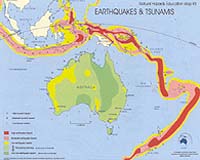
Sydney (AFP) Dec 01, 2006 Australia on Friday launched a new tsunami warning system designed to alert Asia Pacific countries to deadly waves of the kind that killed 250,000 people in the 2004 Boxing Day disaster. The 21.2 million dollar (16.7 million) Australian Tsunami Warning Centre will monitor 39 Australian and 70 international stations, according to scientists at Geoscience Australia in Canberra, where it is based. Geoscience Australia's Phil Cummins said the old system captured data from just a couple of stations, and would not have detected the 2004 tsunami. However the new centre had the potential to save thousands of lives. "There were tens of thousands of people in Thailand and Sri Lanka who didn't get hit by the tsunami until two-to-four hours after the earthquake occurred. They're the kind of people that this warning centre is aimed to protect," he said. While Sri Lanka and Thailand were more geographically vulnerable to tsunamis than Australia, a high impact tsunami could still devastate the country's west coast in our lifetime, Cummins said. Australia was last hit by a tsunami in 2005, the same wave that took more than 600 lives when it reached Java. Working with the Bureau of Meteorology, the 24-hour centre was able to instantly calculate how long it would take before a tsunami hit, delivering that to emergency services who could then alert the public in ninety minutes.
earlier related report Some 220,000 people in a dozen countries were killed by a tsunami that hit off Indonesia on December 26, 2004. The buoy launched Friday is the first deep sea protection system installed in the Indian Ocean to prevent future tragedies. "Two years ago, few people really knew what a tsunami was or how powerful and destructive a tsunami could be," US Ambassador to Thailand Ralph Boyce said. "There were no warning systems then, and most people did not know what to do when they watched the waters recede from the beaches before the waves struck. "With the launching of this buoy, we are taking a big step forwards in better protecting hundreds of millions of people living across the Indian Ocean," he added. The US-funded Deep-Ocean Assessment and Reporting of Tsunamis (DART) consists of a platform that rests on the seabed to detect seismic activity. The platform sends a signal to a buoy floating on the surface of the water, which in turn communicates by satellite to tsunami warning centers around the Indian Ocean. It aims to determine if an earthquake has generated a tsunami, to measure the height of the waves and to predict how long it will take to reach land and how much damage it might cause. Twenty of the DARTs are already deployed across the Atlantic and Pacific, and two more of the 440,000-dollar devices are set to be deployed near Indonesia. The network is expected to expand to 24 devices within two years, financed by donors and individual countries. Phuket's governor Nirand Kalayanamitr said that "with the DART-2 system in the Indian Ocean, Thai people will be safer." "On behalf of six coastal provinces affected by the 2004 tsunami, we commit to work together with the government to protect the lives and property of Thais and tourists who visit Thailand," Nirand said. Some 5,400 people were killed in Thailand when the tsunami struck. Roughly half of them were foreign holidaymakers. The ship carrying the buoy left Phuket later in the afternoon, and will take two days to reach its destination midway between Thailand and Sri Lanka. "There is no better way to honour the memory of all those who perished than by making a concrete effort to prevent or mitigate such a disaster," foreign minister Nitya Pibulsonggram told the people gathered on Panwa pier. "This will bring the safety factor, the confidence, to Thais and our friends from abroad who wish to visit this beautiful island," Nitya said after his visit on the vessel. Curtis Barrett, from the US National Oceanic and Atmospheric Administration, explained that until a regional tsunami warning centre is set up, the signals would go to the Pacific tsunami warning centre in Hawaii. They would then relay that information to 20 countries across the Indian Ocean within minutes. Individual countries would have to alert the local populations. However Barrett acknowledged that the information alone would not save lives unless countries had a way of communicating it to the villagers, fisherman and tourists on the ground. "The information is worthless if it does not get back down to the person on the beach," he said. A second tsunami hit Indonesia in July, killing 650 people and highlighting gaps in the country's warning system. Barrett said that India, Thailand, Indonesia, Malaysia and Australia were vying to build a regional warning centre, and said it would take at least two years before it was finally decided. "All we can do it plant these seeds and hope the system continues," he said. The US government provided the buoy, but the maintenance costs -- which can run to 100 million baht (2.7 million dollars) a year -- are to be covered by the Thai government.
Source: Agence France-Presse Community Email This Article Comment On This Article Related Links - Bringing Order To A World Of Disasters When the Earth Quakes A world of storm and tempest
 Philippines Rescuers Fear Mudslides Toll Could Pass 800
 Legaspi (AFP) Dec 03, 2006
Philippines rescuers Sunday said the death toll from giant mudslides could pass 800 as emergency workers broke through to remote villages devastated by the disaster. As emergency workers and residents continued to dig bodies from the mud, local Red Cross officials said they had confirmed 406 deaths and another 398 missing. |
|
|

| The content herein, unless otherwise known to be public domain, are Copyright 1995-2006 - SpaceDaily.AFP and UPI Wire Stories are copyright Agence France-Presse and United Press International. ESA PortalReports are copyright European Space Agency. All NASA sourced material is public domain. Additionalcopyrights may apply in whole or part to other bona fide parties. Advertising does not imply endorsement,agreement or approval of any opinions, statements or information provided by SpaceDaily on any Web page published or hosted by SpaceDaily. Privacy Statement |